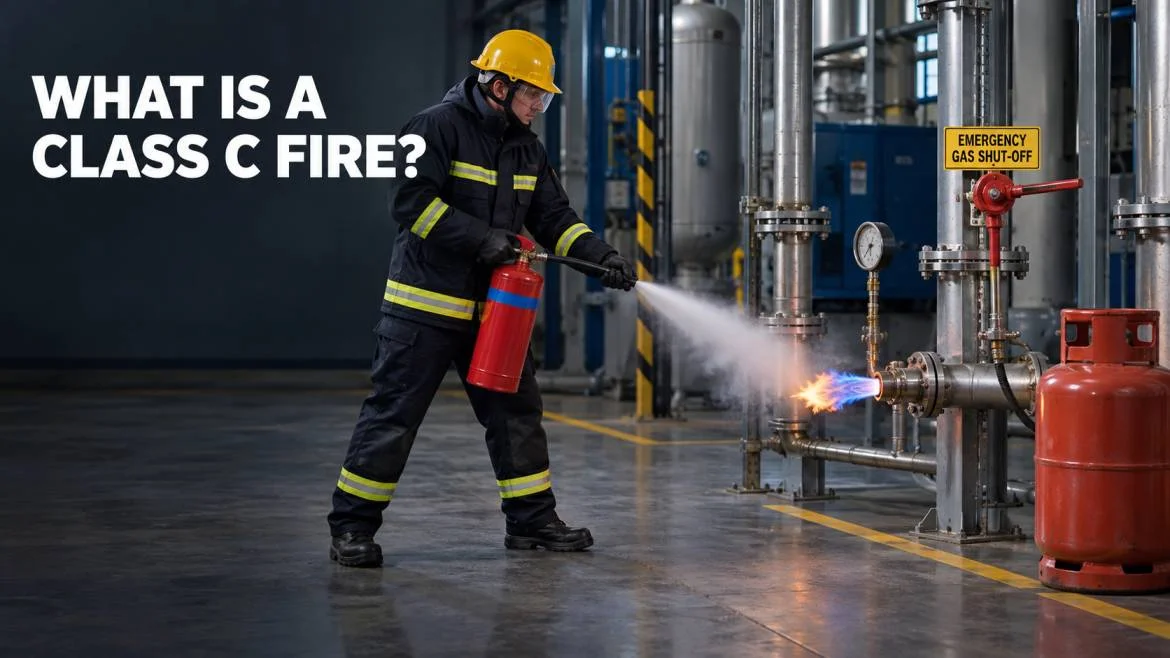
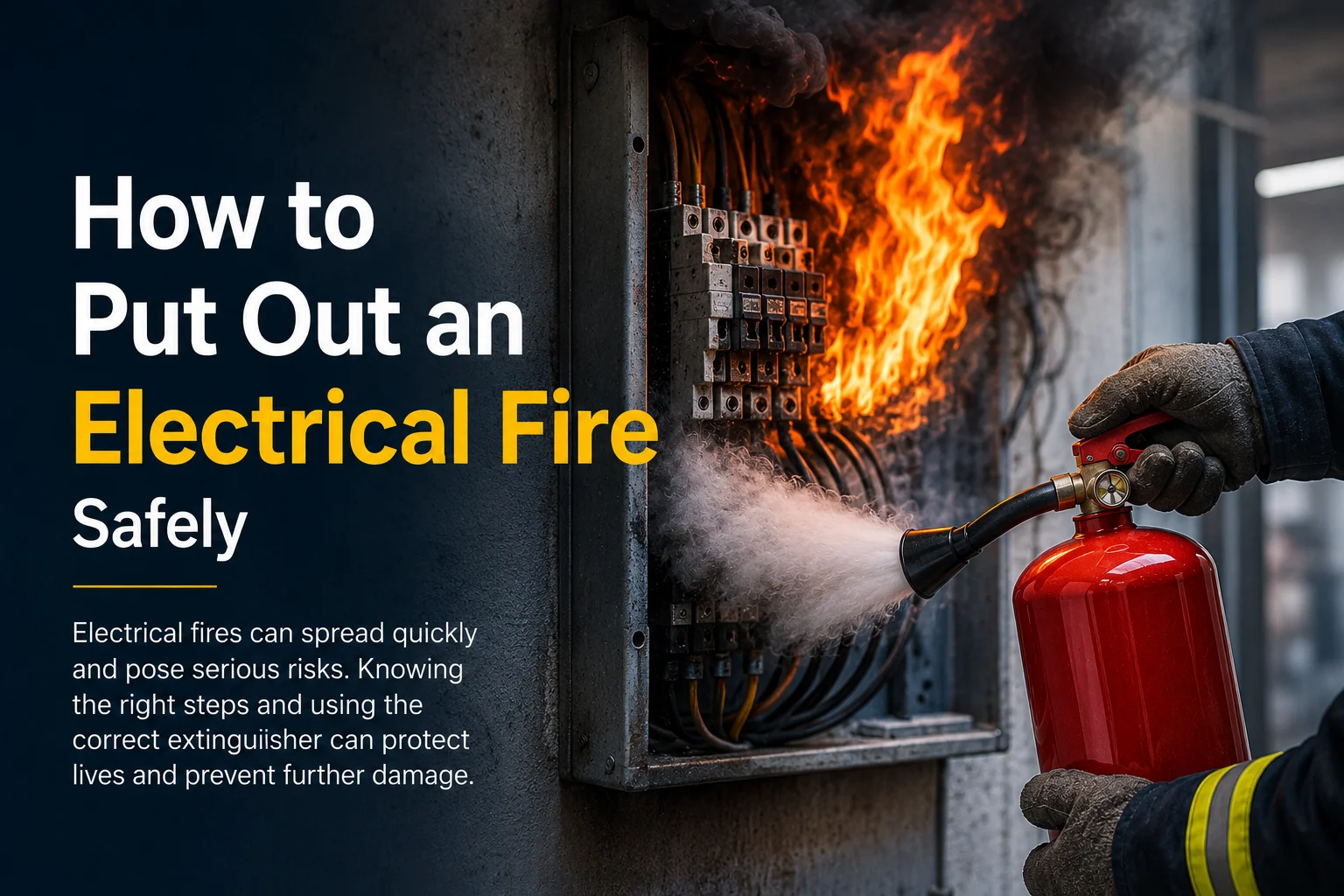
If an electrical fire starts, do not throw water on it while the equipment may still be live. Raise the alarm, move people away, and switch off the power only if you can reach the isolation point without putting yourself at risk. A small fire may be tackled with a suitable extinguisher if you have a clear escape route.
Electrical fires can start from damaged cables, faulty appliances, overloaded circuits, loose connections, or overheating equipment. The priority is always to protect people, not property. If the fire is spreading, producing heavy smoke, or cannot be controlled quickly, leave the area, call the fire service, and do not go back inside.
What Should You Do First When an Electrical Fire Starts?
The first few seconds matter during an electrical fire. Raise the alarm, move people away from the danger, and only try to isolate the electricity if you can do it without approaching the fire or live equipment.
Raise the alarm and warn anyone nearby
Tell anyone nearby that there is a fire and activate the building’s fire alarm if one is available. Do not assume someone else has already raised the alarm.
Move people away from the fire
Keep everyone away from the burning equipment, smoke, exposed wires, and nearby areas that may also be affected. Give yourself enough space to move away quickly if conditions change.
Call the fire service when there is immediate danger
Call the fire service if the fire is spreading, producing heavy smoke, threatening people, or cannot be controlled safely. Do not delay the call while trying to protect equipment or property.
Isolate the electricity only if you can do so safely
If you can safely reach the appliance switch, plug, circuit breaker, or isolation point without going near the fire, switch off the supply. Never put yourself in danger just to disconnect the power.
Safe access: You can reach the switch or breaker without approaching flames, smoke, damaged wiring, or live equipment.
Unsafe access: Reaching the isolation point means moving towards the fire, heavy smoke, damaged cables, or electrical equipment that may still be live. Do not attempt it.
Unknown status: If you cannot confirm whether the equipment is still energised, treat it as live and keep away. Do not take a risk just to find out.
How to Put Out an Electrical Fire Step by Step
If the fire is small, contained, and you can act without putting yourself at risk, follow these steps. If the fire grows or your escape route becomes unsafe, leave immediately and call the fire service.
Step 1: Raise the alarm and assess the danger
Raise the alarm, warn anyone nearby, and assess the size and location of the fire. Look for spreading flames, heavy smoke, exposed wires, and whether you have a clear escape route.
Do not move closer just to get a better view. If the fire is already spreading or smoke is building quickly, evacuate instead of trying to control it.
Step 2: Isolate the electrical supply if it is safe
If you can reach the appliance switch, plug, circuit breaker, or isolation point without approaching the fire, switch off the electrical supply.
Do not try to reach the power source if you would need to move through flames, smoke, or near damaged electrical equipment. Your safety comes first.
Step 3: Choose an extinguisher suitable for the situation
For many fires involving live electrical equipment, a CO₂ extinguisher is a suitable option because it does not leave a residue. A suitably rated dry powder extinguisher may also be appropriate in some situations.
Always check the extinguisher label and rating before use. Never assume that an extinguisher is suitable simply because it is nearby.
Step 4: Keep a clear escape route behind you
Keep your exit route clear before attempting to fight the fire. Never position yourself where spreading flames or smoke could cut off your way out.
Step 5: Apply the extinguisher according to its instructions
If it is safe to intervene, use the extinguisher according to the instructions on the unit. Keep a safe distance and stop immediately if the fire does not respond or conditions start to worsen.
Step 6: Stop immediately if the fire grows or conditions worsen
Leave at once if the flames spread, smoke becomes heavy, the extinguisher is not controlling the fire, or your escape route becomes unsafe. Do not stay and keep trying.
Step 7: Evacuate and stay out if you cannot control it
If the fire cannot be controlled quickly and safely, evacuate the building and call the fire service from a safe location. Do not re-enter, even if the visible flames have disappeared.
What Fire Extinguisher Should You Use on an Electrical Fire?
CO₂ is commonly used for many fires involving live electrical equipment because it does not leave a residue. Dry powder can also be suitable for some electrical risks, but it leaves powder behind and can reduce visibility. Always check the extinguisher rating before use.
| Extinguisher | Electrical equipment | Main consideration |
| CO₂ | Suitable for many live electrical fires | No residue; confined spaces require care |
| Dry powder | Suitable for certain electrical risks | Leaves residue and can reduce visibility |
| Water | Not for live electrical equipment | Shock hazard |
| Foam | Only where specifically rated | Do not assume suitability |
| Water mist | Only where specifically rated | Follow manufacturer instructions |
Having the right extinguisher is only part of fire safety. In workplaces, fire extinguisher installation should ensure suitable extinguishers are placed where they can be reached quickly and safely.
Why CO₂ is commonly used for live electrical equipment
CO₂ extinguishers do not leave a powder or liquid residue, which makes them useful around electrical equipment and electronics. They are suitable for many small fires involving energised equipment when used correctly.
However, CO₂ can be dangerous in small or poorly ventilated spaces because it can reduce the oxygen available to breathe. Leave the area if conditions become unsafe.
When dry powder may be considered
Dry powder can be used for certain electrical fires and may be useful where other types of fire are also present. The main drawback is the residue it leaves behind, which can contaminate equipment and make cleaning difficult.
The powder can also reduce visibility while the extinguisher is being used. For these reasons, check the extinguisher rating and the conditions before deciding to use it.
Why you should check the extinguisher rating
Fire extinguishers are designed for different types of fire. The label shows which fires the extinguisher is suitable for and any limits on its use around electrical equipment.
If you are unsure whether an extinguisher is suitable, do not take a chance. Leave the area and call the fire service if the fire cannot be dealt with safely.
Can You Use Water on an Electrical Fire?
Do not use water on electrical equipment that may still be live. Water can conduct electricity and create a serious risk of electric shock. Use a suitable fire extinguisher instead.
Once the electrical supply has been safely isolated, the shock risk is reduced, but the fire can still involve other materials. Do not assume water is automatically safe; use the correct method for the type of fire.
What If You Don’t Have a Fire Extinguisher?
If you do not have a suitable fire extinguisher, do not take unnecessary risks. Raise the alarm, move away from the fire, and evacuate if you cannot control it safely.
Do not improvise with water
Never use water on electrical equipment that may still be live. It can conduct electricity and cause a serious electric shock.
Should you use a fire blanket?
A fire blanket is not suitable for every electrical fire. Only consider one for a very small, contained fire if the blanket is rated for the situation and you can use it without getting too close.
What about baking soda?
Baking soda may help with some very small fires, but it is not a substitute for a suitable fire extinguisher. Do not approach a live electrical fire to use it.
When evacuation is the safest option
If you do not have the right equipment, the fire is growing, or smoke is increasing, leave immediately and call the fire service from a safe place.
When Should You Leave an Electrical Fire and Call the Fire Service?
Leave immediately and call the fire service if:
- The fire is spreading beyond the original equipment.
- Smoke is heavy or rapidly increasing.
- You cannot safely reach the electrical isolation point.
- The correct extinguisher is unavailable.
- The extinguisher does not control the fire immediately.
- Your escape route could become blocked.
- You are unsure whether it is safe to intervene.
- You have evacuated, and the fire is still active.
- Never re-enter just because the visible flames have disappeared.
What Causes Electrical Fires?
Electrical fires often start when a fault creates too much heat, sparks, or arcing. Damaged wiring, overloaded circuits, faulty appliances, and loose connections can then ignite nearby materials.
| Cause | How it can lead to fire |
| Overloaded sockets and circuits | Too much current can cause dangerous overheating |
| Damaged cables and plugs | Damaged insulation or conductors can cause faults and sparks |
| Faulty appliances | Internal faults can cause overheating or arcing |
| Loose electrical connections | Poor connections can create heat and arcing |
| Misused extension leads | Overloading can cause cables and plugs to overheat |
| Portable heaters | High heat can ignite nearby materials |
| Outdated installations | Older systems may not handle modern electrical demand |
| Overheating equipment | Excess heat can damage components and nearby materials |
How to Prevent Electrical Fires
Simple habits can reduce the risk of an electrical fire. Use electrical equipment correctly, keep cables and sockets in good condition, and act quickly when you notice signs of a fault.
- Avoid overloaded sockets and do not plug extension leads into each other.
- Keep cables away from rugs, carpets, and other places where heat can build up.
- Replace frayed, cracked, or damaged cables, plugs, and sockets.
- Plug high-power appliances directly into a suitable wall socket where possible.
- Keep electrical equipment properly ventilated and away from flammable materials.
- Follow the manufacturer’s instructions for appliances, chargers, and heaters.
- Stop using equipment that is damaged, overheating, or behaving unusually.
- Arrange appropriate electrical inspection and maintenance when required.
- Take warning signs such as flickering lights, buzzing, burning smells, warm sockets, or discolouration seriously.
Arrange appropriate electrical inspections and maintenance when required, including an Electrical Safety Certificate where applicable.
Common Mistakes People Make
During an electrical fire, a quick decision can prevent a small incident from becoming a serious emergency. Avoid these common mistakes.
Using water
Never use water on electrical equipment that may still be live. It can conduct electricity and create a serious shock risk.
Moving the appliance
Do not pick up or move a burning appliance. You could come into contact with live parts or spread the fire.
Standing too close
Keep your distance from smoke, flames, damaged cables, and exposed electrical parts.
Going back inside
Once you leave, stay outside. Do not return for phones, documents, money, or other belongings while the fire is active.
Resetting the breaker
Do not keep resetting a breaker that trips. It may indicate an electrical fault that needs professional attention.
Blocking your escape
Never fight a fire if you cannot keep a clear route behind you. Leave immediately if the fire or smoke starts to spread.
Ignoring hidden heat
Even when the flames disappear, the equipment may still be hot or damaged. The fire could start again.
Restoring power
Do not switch the electricity back on after a fire. Have the electrical system and damaged equipment inspected first.
The Simple Decision Rule
Raise the alarm → move people away → isolate the power if safe → use suitable firefighting equipment only if the fire is small and conditions are safe → keep an escape route → evacuate if the fire grows or cannot be controlled → call the fire service → do not re-enter.
Need Professional Electrical & Fire Safety Checks?
London Safety Checks provides expert electrical and fire risk assessment services, including EICR testing, fire extinguisher services, emergency lighting, and fire door inspections. Keep your property safe with the right checks and maintenance.
Frequently Asked Questions
How do you put out an electrical fire?
Raise the alarm, move away from the fire, and isolate the power only if you can do so safely. For a small fire, use a suitable extinguisher with a clear escape route. Evacuate if it grows.
Can you put water on an electrical fire?
No. Do not use water while electrical equipment may still be live. It can conduct electricity and create a serious shock risk.
What is the best extinguisher for an electrical fire?
CO₂ is commonly used for many fires involving live electrical equipment. Dry powder may also be suitable for some electrical risks. Always check the extinguisher rating first.
How do you put out an electrical fire without an extinguisher?
If you do not have a suitable extinguisher, do not use water or improvise with household items. Raise the alarm, move away from the fire, and evacuate if you cannot control it safely. Call the fire service from a safe place.
Can you use a fire blanket on an electrical fire?
Only in limited situations. A fire blanket may be considered for a small, contained fire when the blanket is suitable and using it does not put you at risk.
What should you do if an electrical fire starts in a socket?
Raise the alarm and move away from the socket. Isolate the power only if you can reach the correct switch or breaker safely. Do not use water.
Should you turn off the main breaker during an electrical fire?
Turn off the relevant electrical supply only if you can reach it without approaching flames, smoke, or damaged equipment. Never put yourself at risk to disconnect the power.
What should you do if an electrical appliance catches fire?
If safe, switch off and isolate the appliance. Do not move it or use water. If the fire is not quickly controlled, evacuate and call the fire service.
Can an electrical fire start again after it is extinguished?
Yes. Heat, damaged components, or an unresolved electrical fault can cause the fire to restart. Keep the power off and have the system inspected before using it again.
What should you do after an electrical fire?
Do not restore power or reuse damaged equipment. Have the electrical system inspected by a qualified professional and make sure any firefighting equipment used is serviced or replaced.