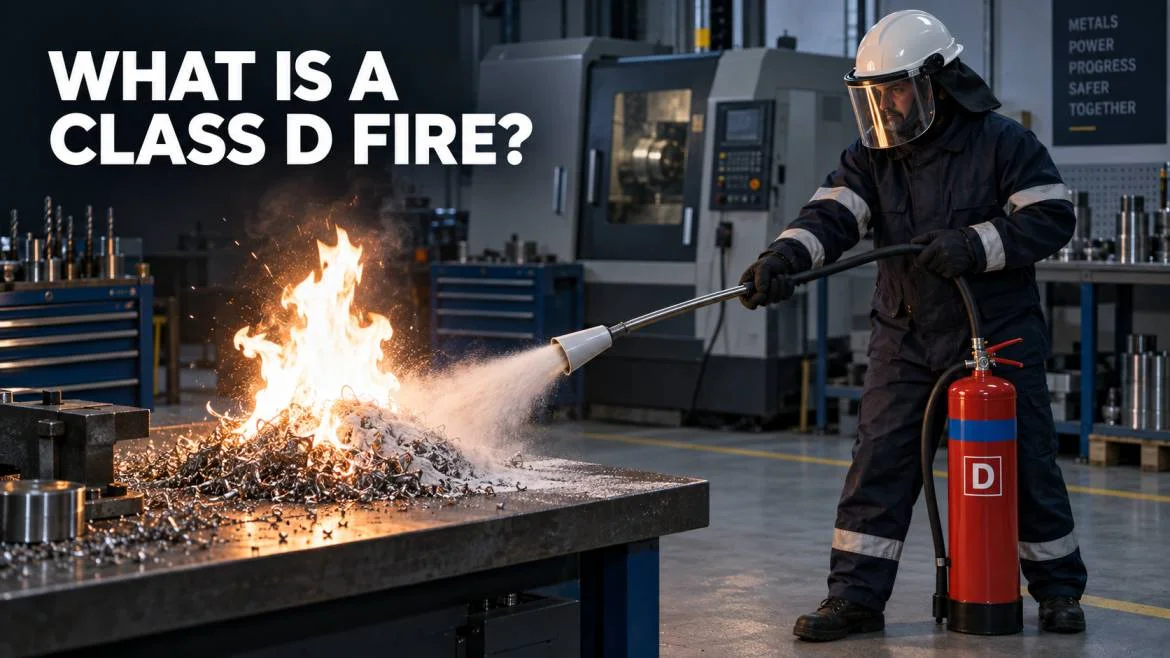
A Class D fire is a fire involving combustible metals, such as magnesium, titanium, sodium, potassium, or lithium metal. These fires need a specialist metal-fire powder extinguisher matched to the metal involved. Water, foam, CO₂, and ordinary multipurpose powder may be ineffective or make the situation more dangerous.
This guide explains which metals can burn, what causes Class D fires, where they occur, which extinguisher should be used, and how workplaces can reduce the risk.
What Is a Class D Fire?
A Class D fire involves a combustible metal as its fuel. Under the UK fire classification system, fires are grouped by the material burning. Class D is the category for metal fires. The classification comes from BS EN 2, the standard used to classify fires by fuel type.
Metal may not look like a typical fire risk. Large, solid pieces are often difficult to ignite because they can transfer heat away from the ignition point. The risk changes when the same metal becomes dust, powder, thin shavings, or swarf.
Why Can Certain Metals Catch Fire?
A metal becomes easier to ignite when more of its surface is exposed to oxygen. Fine aluminium powder, for example, behaves very differently from a solid aluminium sheet. Machining, grinding, cutting and polishing can produce:
- Fine metal dust
- Loose powder
- Small particles
- Thin shavings
- Metal swarf
These materials can ignite from heat, sparks, friction or static discharge. Once alight, some combustible metals burn quickly and at very high temperatures.
Which Metals Can Cause a Class D Fire?
Class D fires can involve several combustible or reactive metals. The risk depends on the type of metal, its physical form and the conditions in which it is handled.
| Metal | Higher-risk form | Where it may be found |
| Magnesium | Dust, powder and swarf | Automotive, aerospace and engineering work |
| Titanium | Grinding dust and fine particles | Aerospace and precision engineering |
| Aluminium | Fine dust and powder | Manufacturing, machining and metal 3D printing |
| Sodium | Pure reactive metal | Laboratories and chemical facilities |
| Potassium | Pure reactive metal | Laboratories and specialist manufacturing |
| Lithium | Pure metallic lithium | Research and specialist industrial settings |
| Zirconium | Dust and fine particles | Specialist engineering and industrial work |
Not every item made from these metals presents the same risk. An aluminium drink can or solid titanium component, is not as easy to ignite as a cloud or pile of fine metal dust. The safety data sheet for the material should be checked because alloys, powders and pure metals may behave differently.
What Causes a Class D Fire?
Most Class D fires occur when combustible metal particles meet a suitable ignition source. The risk increases when dust and swarf are allowed to collect around machinery or work areas. Common causes include:
- Sparks produced by grinding, cutting or machining
- Friction from tools or moving machinery
- Overheated equipment and hot surfaces
- Welding and other hot work
- Static electrical discharge near metal powder
- Open flames and smoking
- Poorly controlled metal dust
- Incorrect storage of reactive metals
- Contact between water-reactive metals and moisture
- Mixing incompatible materials
Several factors may contribute to one incident. A machining process might create magnesium swarf, provide heat through friction and leave the waste close to another ignition source.
Where Are Class D Fire Risks Commonly Found?
Class D fire risks are most common in workplaces where combustible metals are cut, ground, machined, stored or processed. These include CNC workshops, engineering and fabrication sites, automotive and aerospace plants, laboratories, chemical facilities and metal-powder production areas. Additive manufacturing sites may also face this hazard when fine metal powders are handled during daily operations.
Risk is not limited to businesses that use combustible metals as their main material. A small quantity of magnesium swarf, aluminium dust or incorrectly stored reactive metal can still create a serious hazard. A professional fire risk assessment should examine the material’s form, storage conditions, ignition sources, cleaning methods, waste handling and potential employee exposure.
Why Are Class D Fires Dangerous?
Class D fires are dangerous because burning metals can produce intense heat, spread quickly through loose dust or swarf and react violently with unsuitable extinguishing agents. Depending on the material, they may also release harmful fumes or continue burning beneath the extinguishing powder. Hot metal can reignite after the flames disappear, so the nearest extinguisher should never be used without checking its Class D rating and metal compatibility.
What Extinguisher Is Used for a Class D Fire?
A Class D fire requires a specialist dry powder extinguisher approved for metal fires. The powder must be suitable for the exact metal involved because there is no single extinguishing agent that is appropriate for every combustible metal.
Metal-fire extinguishers may contain formulations sold as M28, L2 or another specialist powder. These products are not automatically interchangeable. Their suitability depends on the metal, the extinguisher manufacturer and the product’s tested fire rating. Before selecting an extinguisher, check:
- Which metals are present
- The form and quantity of the material
- The extinguisher label
- The manufacturer’s instructions
- The material’s safety data sheet
- The findings of the fire risk assessment
Ordinary ABC dry powder extinguishers are not the same as Class D metal-fire extinguishers.Ordinary ABC dry powder extinguishers are not the same as Class D metal-fire extinguishers. Regular fire extinguisher servicing helps confirm that each extinguisher remains suitable for the identified risks, clearly labelled, correctly positioned and ready to operate in an emergency.
How Does a Class D Extinguisher Work?
A Class D extinguisher applies specialist powder gently over the burning metal. The powder smothers the material, limits its contact with oxygen, absorbs heat and may form a protective layer that helps control the fire. A low-velocity applicator is used to avoid disturbing metal dust or swarf, as a forceful discharge could scatter burning particles and spread the fire.
Why Should Water Not Be Used on a Class D Fire?
Water must not be used on a Class D fire unless specialist guidance for the exact material states otherwise. Certain combustible metals react with water, producing more heat and flammable hydrogen. This can intensify the fire or cause a violent reaction.
Other common extinguishing agents may also be unsafe or ineffective.
| Extinguishing agent | Why it is unsuitable |
| Water | Can react with certain burning metals and make the incident more severe |
| Foam | Usually contains water and may react with the metal |
| CO₂ | May not suppress the burning metal and its discharge can disturb loose particles |
| Standard ABC powder | Is not designed or tested for combustible-metal fires |
| Unapproved sand | May contain moisture or contaminants and is not a substitute for an approved agent |
The correct response depends on the metal involved. Do not improvise with an extinguishing material that has not been assessed for that hazard.
What Should You Do If a Class D Fire Starts?
If a metal fire starts:
- Raise the fire alarm immediately.
- Call 999 and tell the fire service which metal is involved, if known.
- Evacuate people from the affected area.
- Close doors behind you where it is safe to do so.
- Do not use water, foam or the nearest standard extinguisher.
- Only a trained person should consider using the correct Class D extinguisher.
- Keep a clear escape route and never place yourself between the fire and the exit.
- Leave the powder layer undisturbed after application because the metal may remain hot and reignite.
Portable extinguishers are intended for small, early-stage fires. If the fire is spreading, producing heavy smoke or blocking the escape route, evacuate rather than attempting to fight it.
Is a Lithium-Ion Battery Fire a Class D Fire?
A lithium-ion battery fire is not normally classified as a Class D fire. The word “lithium” causes confusion, but pure lithium metal and lithium-ion batteries present different hazards.
Pure metallic lithium is a combustible metal and can be involved in a Class D fire. Lithium-ion batteries generally contain lithium compounds rather than a block of pure lithium metal. When damaged, overheated or internally faulty, the cells can enter thermal runaway, causing a self-sustaining rise in temperature. The correct response to a lithium-ion battery incident depends on the battery chemistry, size, location and manufacturer’s guidance. A Class D extinguisher should not automatically be selected simply because a battery contains the word lithium.
How Can Class D Fires Be Prevented?
Prevention starts with knowing which combustible metals are present and how work activities change their form.
Practical control measures include:
- Identify combustible metals and review their safety data sheets.
- Prevent metal dust, powder and swarf from accumulating.
- Use extraction equipment designed for the material being collected.
- Do not spread combustible dust with compressed air.
- Keep reactive metals away from water and moisture.
- Store metals in suitable, clearly labelled containers.
- Separate incompatible materials.
- Control welding, grinding and other hot work.
- Reduce static discharge where metal powders are handled.
- Inspect and maintain machinery.
- Provide extinguishers suitable for the metals on site.
- Train employees in alarm, evacuation and emergency procedures.
The Dangerous Substances and Explosive Atmospheres Regulations 2002 require employers to identify dangerous substances, assess fire and explosion risks, introduce suitable controls and prepare emergency procedures. HSE guidance specifically includes dust created by machining and sanding among the substances that may need to be assessed.
Summary
A Class D fire involves combustible metals, particularly when they are present as dust, powder, shavings or swarf. These fires require a specialist metal-fire extinguisher matched to the material involved. Water and common extinguishers may worsen the incident. Proper storage, dust control, equipment selection, staff training and a suitable risk assessment are central to prevention.
Check Your Workplace Fire Protection
If your premises store, process, or machine combustible metals, the correct extinguisher and an up-to-date risk assessment are essential. London Safety Checks can assess the fire risks within your workplace and check whether your extinguishers are suitable for the materials present. Contact our team to arrange a professional fire safety inspection.
Class D Fire FAQs
What is an example of a Class D fire?
A fire involving magnesium swarf produced during machining is an example of a Class D fire. Other examples include burning titanium dust, aluminium powder or pure sodium.
Are all burning metals classified as Class D?
Class D covers fires involving combustible metals. However, not every metal burns easily, and the same metal may present a much greater fire risk as dust or powder than as a large solid object.
Are Class D fires common?
Class D fires are rare compared with fires involving solid materials or flammable liquids. They remain a serious risk in engineering, aerospace, laboratories, metalworking and other workplaces handling combustible metals.
Can a Class D extinguisher be used on other fires?
A Class D extinguisher is designed for specified combustible metals. It should not be treated as a general-purpose extinguisher for Class A, B, C or F fires.
What colour is a Class D fire extinguisher in the UK?
UK fire extinguishers normally have a red body, while dry powder is identified by a blue colour panel. Colour alone is not enough because standard powder and metal-fire powder are different. Check the label for the Class D rating and compatible metals.
Can sand be used on a Class D fire?
Do not use ordinary sand as a substitute for an approved Class D agent. Sand may contain moisture or contaminants, and its suitability varies according to the metal involved. Follow the site’s emergency plan and material-specific guidance.
Can a Class D fire reignite?
Yes. Burning metal may remain hot beneath the powder after visible flames disappear. The extinguishing layer should be left undisturbed, and the area should be checked by the fire and rescue service.
Who should use a Class D fire extinguisher?
Only someone who has received suitable training should consider using one, and only when the fire is small, the correct extinguisher is available and there is a safe escape route.