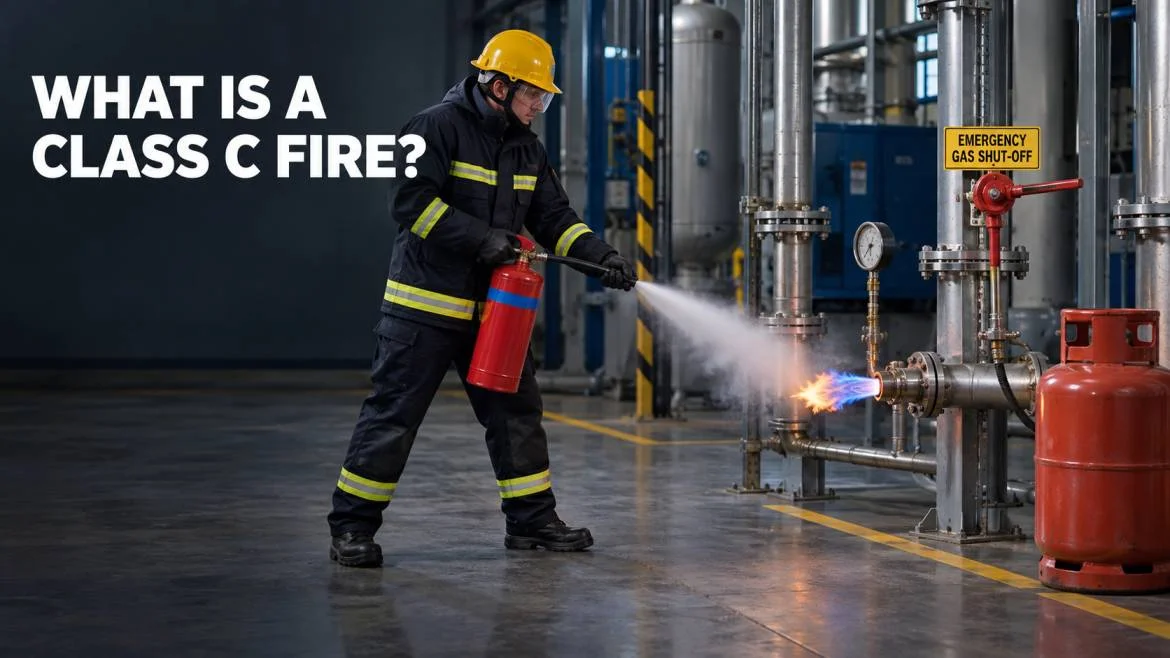
A Class C fire is a fire involving flammable gases, such as propane, butane, methane, hydrogen or acetylene. These fires can spread rapidly while gas continues to escape. A Class C-rated dry powder extinguisher is normally used, but raising the alarm, evacuating and safely isolating the gas supply take priority over fighting the flames.
This guide explains which gases fall under Class C, how these fires start, which extinguisher is suitable, and what to do if you discover a gas fire or suspected leak.
What Is a Class C Fire?
A Class C fire is one fuelled by a flammable gas. The classification is based on the material sustaining the flames rather than the source that first ignited them. Propane, butane, methane, hydrogen and acetylene are common Class C fuels.
The UK system follows BS EN 2, which groups fires according to the nature of the burning fuel. An unignited gas leak is not yet a Class C fire, but it may create a flammable atmosphere that could ignite suddenly.
Does Class C Mean an Electrical Fire?
In the UK and European classification system, Class C means a fire involving flammable gas. Electrical fires are not treated as a separate fire class in the UK; the appropriate extinguisher depends on the burning material and whether the electrical equipment remains live.
The terminology differs in the United States, where Class C commonly refers to fires involving energised electrical equipment.
What Type of Fuel Is Involved in a Class C Fire?
Class C fires are sustained by gases that can burn when mixed with air and exposed to an ignition source. These gases may be supplied through fixed pipework, stored in pressurised cylinders or produced during industrial processes.
| Flammable gas | Common use or location |
| Propane | LPG heating, barbecues, catering and industrial equipment |
| Butane | Portable heaters, camping stoves and gas canisters |
| Methane | Mains natural gas, heating and industrial processes |
| Acetylene | Welding, brazing and metal cutting |
| Hydrogen | Laboratories, manufacturing and energy applications |
These gases do not all move in the same way after a leak. Propane and butane are heavier than air and may collect near floors, drains or other low areas. Methane and hydrogen are lighter than air and tend to rise. Ventilation and gas detection must therefore suit the particular gas being used.
Some supplied gases have an odour added to help people notice a leak, but others may have little or no detectable smell. Smell should never be the only method used to identify a gas hazard.
What Causes a Class C Fire?
A Class C fire usually starts when escaping flammable gas mixes with air and reaches an ignition source. The leak creates the fuel, while a spark, flame or hot surface provides enough energy to ignite it.
Common causes include:
- Damaged gas hoses, pipes or connections
- Faulty regulators, valves or seals
- Poorly maintained gas appliances
- Incorrect appliance or pipework installation
- Corroded, damaged or leaking cylinders
- Open flames and smoking
- Sparks from electrical equipment
- Welding, grinding and other hot work
- Static electrical discharge
- Overheated machinery or hot surfaces
- Poor ventilation around gas equipment
- Incorrect storage or handling of cylinders
More than one failure may contribute to an incident. For example, a damaged propane hose may release gas into a poorly ventilated space before a nearby electrical switch provides the ignition source.
Where Are Class C Fire Risks Commonly Found?
Class C risks are present wherever flammable gases are stored, supplied or used. Common locations include commercial kitchens, restaurants, boiler rooms, welding workshops, garages, construction sites, laboratories, chemical plants and LPG storage areas. Homes may also carry a risk where natural gas, portable heaters, barbecues or bottled LPG are used.
The level of risk depends on the gas, quantity, equipment, ventilation and nearby ignition sources. A small cylinder that is damaged or stored incorrectly can still create a dangerous gas cloud. Businesses should consider normal operation, cylinder changes, maintenance work and possible leaks when assessing the hazard.
Why Are Class C Fires Dangerous?
Class C fires are dangerous because gas may spread beyond the original leak before it ignites. When a suitable concentration of gas mixes with air, ignition can cause a flash fire or explosion. Pressurised cylinders may also heat up, rupture or release more fuel. Even if the visible flame is extinguished, escaping gas can accumulate and ignite again unless the supply is controlled.
What Extinguisher Is Used for a Class C Fire?
A dry powder extinguisher carrying a Class C rating is normally used for fires involving flammable gases. Standard ABC dry powder extinguishers can be rated for Class A, B and C fires, but the rating must always be confirmed on the extinguisher label.
Dry powder extinguishers have a red cylinder with a blue identification panel or band. The blue marking identifies the extinguishing agent as powder; it does not, by itself, prove that the extinguisher is suitable for every gas hazard.
Powder can reduce visibility, irritate breathing and contaminate equipment, so it is generally unsuitable for small or enclosed areas unless the risk assessment identifies it as necessary. The extinguisher type, size and location should be chosen for the premises rather than selected from colour alone.
Regular fire extinguisher servicing in London helps confirm that extinguishers remain correctly rated, positioned, labelled and ready to operate.
How Does a Dry Powder Extinguisher Work?
A dry powder extinguisher releases fine chemical powder into the flames. The powder interrupts the chemical chain reaction that keeps combustion going, causing the visible flame to collapse.
Powder provides little cooling compared with water-based extinguishers. A hot surface or continuing gas release may therefore cause the fire to reignite. Extinguishing the flame does not repair the leak or remove the surrounding gas hazard.
Why Must the Gas Supply Be Isolated?
The gas supply should be isolated because the fire may continue for as long as fuel is escaping. If the visible flame is extinguished while the leak continues, unburned gas can collect and form an explosive mixture with air.
Only close a valve or emergency control when it can be reached without entering smoke, flames or an affected area. Employees expected to isolate gas during an emergency should know the location of the controls and receive suitable training. If safe isolation is not possible, evacuate and leave the incident to the fire and rescue service.
What Should You Do If a Class C Fire Starts?
If a flammable gas catches fire:
- Raise the fire alarm immediately.
- Call 999 and explain that flammable gas may be involved.
- Evacuate the affected area.
- Keep people away from cylinders, tanks and gas pipework.
- Isolate the gas supply only if you are trained and can reach the control safely.
- Do not operate electrical switches near a suspected gas release.
- Only a trained person should consider using a correctly rated dry powder extinguisher on a small fire.
- Maintain a clear escape route at all times.
- Leave immediately if the fire grows, smoke increases or the cylinder becomes heated.
- Do not re-enter until the fire and rescue service says the area is safe.
Portable extinguishers are intended for small, early-stage fires. They should not be used when the flames are spreading, the fuel supply cannot be controlled or the person using the extinguisher could become trapped.
What Should You Do If You Smell Gas but There Is No Fire?
A suspected gas leak requires immediate action even when no flames are visible. Do not smoke, light a match or create any other naked flame. Avoid switching electrical equipment on or off because operating a switch may create a spark.
Open doors and windows when this can be done safely, turn off the gas at the emergency control valve if it is readily accessible, and move everyone away from the affected area. Call the National Gas Emergency Service on 0800 111 999 from a safe location. Faulty appliances and installations should only be checked by a suitably qualified Gas Safe registered engineer.
Which Extinguishers Should Not Be Used on a Class C Fire?
Extinguishers designed for other fuels should not be used simply because they are nearby.
| Extinguisher | Why it is unsuitable |
| Water | Not rated for flammable gas fires and does not stop the escaping fuel |
| Foam | Designed mainly for Class A solids and Class B liquids |
| CO₂ | Not normally Class C-rated and provides little cooling against reignition |
| Wet chemical | Designed mainly for Class F cooking oil and fat fires |
| Class D powder | Formulated for combustible metals rather than flammable gases |
Water may be used by firefighters to cool exposed cylinders or equipment, but that is different from using a portable water extinguisher on the gas flame. Members of the public should not approach a heated cylinder or attempt to cool it themselves.
How Can Class C Fires Be Prevented?
Prevention depends on stopping leaks, controlling ignition sources and ensuring gas cannot collect unnoticed.
Practical measures include:
- Use appropriately qualified Gas Safe registered engineers.
- Maintain gas appliances, pipework, valves and safety devices.
- Check hoses, regulators and cylinders for visible damage.
- Replace damaged or expired components.
- Store cylinders upright in suitable, ventilated areas.
- Protect cylinders from heat, impact and unauthorised access.
- Keep gas equipment away from flames, sparks and hot surfaces.
- Never check for a leak with a naked flame.
- Use suitable ventilation and gas detection where required.
- Control welding, cutting and other hot work.
- Prevent the use of unsuitable electrical equipment in hazardous areas.
- Train employees in alarm, isolation and evacuation procedures.
- Keep the correct extinguishers serviced and accessible.
- Review controls whenever equipment, gas types or work activities change.
A professional fire risk assessment in London can identify gas-related ignition sources, people at risk, suitable control measures and the firefighting equipment required for the premises.
Workplaces using flammable gases may also fall under the Dangerous Substances and Explosive Atmospheres Regulations 2002. DSEAR requires employers to assess and control risks from dangerous substances that could cause fire or explosion.
Summary
A Class C fire involves flammable gas such as propane, butane, methane, hydrogen or acetylene. Dry powder is the usual portable extinguishing agent, but stopping the gas supply safely is critical. Raise the alarm, evacuate and call 999 before considering firefighting. Proper storage, ventilation, maintenance, staff training and risk assessment help prevent gas fires.
Class C Fire FAQs
What is a Class C fire in the UK?
A Class C fire is a fire involving flammable gas. Common fuels include propane, butane, methane, hydrogen and acetylene.
What type of fuel is involved in a Class C fire?
Class C fires involve fuel in a gaseous state. The gas may come from a cylinder, fixed pipework, storage tank, appliance or industrial process.
Is natural gas a Class C fire risk?
Yes. Natural gas consists mainly of methane, which is flammable. A leak can create a Class C fire or explosion risk if the gas mixes with air and reaches an ignition source.
Is LPG classified as Class C?
A fire involving released LPG is treated as a Class C gas fire. LPG normally contains propane, butane or a mixture of both and is stored as a liquid under pressure.
What colour is a Class C fire extinguisher?
Dry powder extinguishers have a blue identification band or panel on a red cylinder. Check the label for a Class C rating because the colour only identifies the agent inside.
Can water be used on a Class C fire?
A portable water extinguisher should not be used on a flammable gas fire. It does not stop the gas supply or interrupt the gas flame effectively.
Can CO₂ be used on a Class C fire?
CO₂ extinguishers are not normally rated for Class C fires in the UK. They may temporarily affect the flame but do not stop the gas leak and provide little protection against reignition.
Is a Class C fire electrical?
Not in the UK. Class C means flammable gas under the UK and European system. The electrical meaning comes from the fire classification used in the United States.
Are Class C fires common in homes?
They are less common than Class A fires, but a risk exists wherever natural gas, LPG cylinders, gas heaters, cookers or barbecues are used. Correct installation, ventilation and maintenance reduce that risk.
Check Your Gas Fire Safety Measures
If your premises uses LPG, natural gas or another flammable gas, the equipment and emergency plan should reflect that specific risk. London Safety Checks can assess your fire precautions and check whether your extinguishers are suitable, correctly positioned and properly maintained. Contact our team to arrange a professional fire safety inspection.