
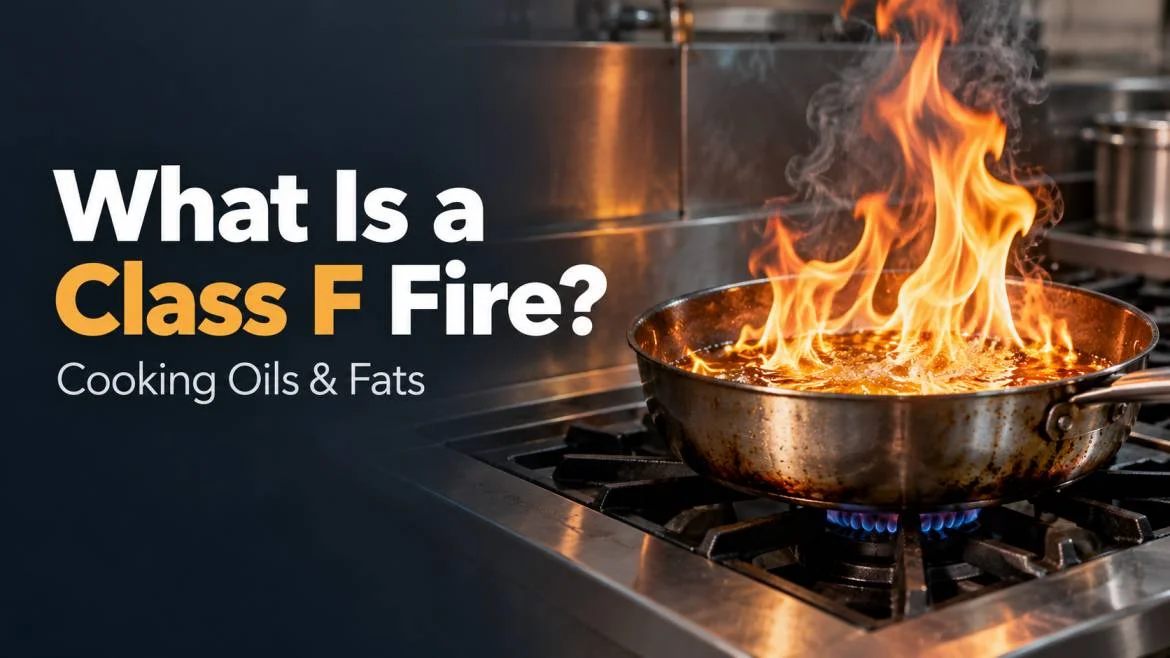
A Class F fire is a fire involving cooking oils or fats in cooking appliances, such as chip pans and deep fat fryers. These fires require equipment suited to hot cooking media, usually a wet chemical extinguisher. Adding water can violently spread burning oil, while insufficient cooling can allow the fire to reignite.
This guide explains what burns in a Class F fire, how it starts, which extinguishers are suitable, and how to reduce the risk at home or in a commercial kitchen.
Table of Contents
- What is a Class F fire?
- What causes Class F fires?
- Why are Class F fires dangerous?
- What should you do if a Class F fire starts?
- Which fire extinguisher is suitable?
- Can you use a fire blanket?
- How can you prevent Class F fires?
- How does Class F differ from Class B?
- Key points
- Frequently asked questions
What Is a Class F Fire?
Class F describes fires involving vegetable or animal oils and fats used for cooking. Common examples include burning oil in a deep fat fryer, chip pan or frying pan. The classification identifies the burning fuel and helps determine suitable firefighting equipment; it does not describe every fire that happens in a kitchen.
What Is Burning in a Type F Fire?
The fuel burning in a Type F fire is cooking oil or fat. Examples include sunflower oil, olive oil, vegetable oil, and lard. “Type F fire” is another expression people use when referring to a Class F cooking oil or fat fire.
| Example | Burning fuel |
| Chip pan fire | Oil or fat used for frying |
| Restaurant deep fat fryer fire | Cooking oil in the fryer |
| Frying pan containing burning oil | Heated cooking oil or fat |
The appliance’s power source does not identify the burning fuel. For example, burning oil in an electric fryer is a cooking-media fire, while a fault involving its live electrical components presents an additional electrical hazard.
What Causes Class F Fires?
Class F fires can start when cooking oil or fat overheats and ignites. Leaving hot oil unattended allows heating to continue without anyone noticing warning signs. Faulty temperature controls can also prevent a fryer from maintaining a safe operating temperature. London Fire Brigade warns that hot oil can easily overheat and catch fire.
Overfilling introduces another risk: food displaces oil, potentially causing it to overflow onto hot surfaces. Food water can also cause hot oil to spit. Grease accumulated on hobs, cooker hoods and extraction equipment creates further material that can ignite and help a kitchen fire spread.
Can Cooking Oil Catch Fire Without a Flame?
Yes. If oil reaches its autoignition temperature, it can ignite without a separate flame or spark. This differs from its flash point, where vapour can ignite in the presence of an ignition source. Smoking occurs at another threshold and should not be treated as a precise measurement of ignition risk.
| Term | Meaning |
| Smoke point | The temperature at which oil begins producing visible smoke |
| Flash point | The temperature at which vapour can ignite when an ignition source is present |
| Autoignition temperature | The temperature at which ignition can occur without an external ignition source |
There is no single ignition temperature that applies to every cooking oil under every condition. For practical cooking safety, London Fire Brigade advises switching off the heat and allowing the oil to cool if it starts smoking. Do not continue heating it to see whether flames develop.
Why Are Class F Fires Dangerous?
Class F fires combine burning liquid with a reservoir of hot oil that can retain enough heat to reignite. Extinguishing visible flames does not necessarily make the oil safe. Disturbing or splashing the burning contents can also spread the fire beyond the appliance and expose people nearby to serious burns.
This explains why cooking oil fires need an extinguishing method that addresses both the flames and the retained heat. Equipment that temporarily suppresses combustion without providing suitable cooling may fail to prevent the fire from returning.
Why Should You Never Put Water on Burning Oil?
Water entering very hot oil rapidly turns into steam. The expanding steam can project burning oil out of the pan, spreading flames onto nearby surfaces and people. London Fire Brigade warns that throwing water onto a pan fire can create a fireball. Even a small container of water is unsafe. London Fire Brigade
Pouring water onto burning oil is different from using a purpose-designed, tested water mist extinguisher. Specialist equipment controls how the agent is discharged; its suitability must be confirmed by an explicit Class F rating and the manufacturer’s instructions.
What Should You Do If a Class F Fire Starts?
For a pan fire at home, prioritise getting people away from danger. Do not move the pan or attempt to carry it outside. London Fire Brigade advises householders against tackling the fire themselves, even when equipment is available. Turning off the heat is appropriate only when it can be done safely.
What Should You Do During a Pan Fire at Home?
- Keep away from the burning pan.
- Do not add water or try to move it.
- Switch off the heat only if you can do so safely.
- Leave the room and close the door behind you.
- Warn others and call 999 from a safe place.
These steps follow London Fire Brigade’s pan-fire guidance. Do not delay leaving while searching for a blanket or extinguisher.
When May Trained Kitchen Staff Use Firefighting Equipment?
In a commercial kitchen, any equipment use must follow staff training and the premises’ emergency procedure. Staff need to understand when to evacuate as well as how to use an extinguisher. London Fire Brigade recommends suitable firefighting equipment, trained staff, clear escape routes and a recorded evacuation plan.
A spreading fire, heavy smoke or a threatened escape route is a reason to leave. It is not a signal to approach the fire with a larger extinguisher.
Which Fire Extinguisher Is Suitable for a Class F Fire?
A wet chemical fire extinguisher carrying an appropriate F rating is the usual specialist choice for cooking oil and fat fires. It is designed to cool the burning cooking media and form a protective surface layer. Some other purpose-designed extinguishers also carry F ratings, so suitability must be checked on the specific product.
How Does a Wet Chemical Extinguisher Work?
Wet chemical extinguishers commonly contain potassium-based solutions. Their gentle discharge helps reduce splashing while cooling the fire. The agent reacts at the oil’s surface to create a soap-like protective layer through saponification. This layer helps suppress combustion and reduce the chance of reignition as the oil cools.
The discharge technique, operating distance and electrical precautions depend on the model. Staff should learn these from practical training and the manufacturer’s instructions before an emergency occurs.
How Do You Identify a Suitable Class F Extinguisher?
UK wet chemical extinguishers normally have a red body with a yellow identification panel. Check the label for an F rating, such as 25F or 75F, rather than relying on colour alone. The rating describes tested firefighting performance; it is different from the volume of agent inside the extinguisher.
For example, an extinguisher containing six litres of agent may carry a 75F rating. This does not mean it contains 75 litres, nor does it guarantee suitability for every fryer installation. Equipment selection should consider the cooking appliances and the assessed fire risk.
| Equipment | Suitability for a Class F fire |
| Appropriately F-rated wet chemical extinguisher | Usual specialist choice |
| Specialist water mist extinguisher with an explicit F rating | Suitable only within its tested rating and instructions |
| Ordinary water extinguisher or poured water | Do not use on burning cooking oil |
| Standard CO₂ extinguisher | Not suitable protection for deep fat fryer fires |
| Standard ABC powder extinguisher without an F rating | Do not assume suitability |
| Standard foam extinguisher without an F rating | Do not assume suitability |
Manufacturer specifications show F-rated water mist products alongside wet chemical models. Ordinary water, standard foam and other general-purpose extinguishers should not be substituted simply because they are nearby.
Can You Use a Fire Blanket on a Class F Fire?
A suitable fire blanket can have a role in controlling a small, contained cooking oil or fat fire, subject to its instructions and the user’s training. Government workplace guidance recognises this application. However, that does not override London Fire Brigade’s advice that householders should leave a pan fire rather than tackle it. GOV.UK
A blanket should not be treated as a universal replacement for protection selected for a commercial fryer. Its dimensions, intended application and safe accessibility matter. Government guidance recommends locating blankets near the relevant hazard where they can still be reached safely during a fire.
Do not assume that removing a blanket after a fixed waiting period is safe. Hot oil may remain capable of reigniting; follow the emergency response and equipment instructions rather than checking underneath a covering.
You may like to read: 4 types of fire extinguisher
How Can You Prevent Class F Fires?
Preventing Class F fires starts with controlling heat, supervising cooking and keeping equipment clean. At home, safe filling and temperature-controlled fryers reduce risk. In commercial kitchens, these measures need to be supported by equipment maintenance, staff training and a fire risk assessment addressing the actual cooking operations.
How Can You Reduce Cooking Oil Fire Risks at Home?
- Stay with cooking that involves hot oil.
- Never fill a chip pan more than one-third full of oil or fat.
- Follow the marked filling limits on electric fryers.
- Keep food dry before placing it in hot oil.
- Switch off the heat if oil begins smoking.
- Keep the hob, cooker hood and extractor clean.
- Use a temperature-controlled electric fryer instead of a traditional chip pan where possible.
London Fire Brigade recommends these precautions for deep fat frying.
Fit a suitable heat alarm in the kitchen and follow its installation instructions. Heat alarms respond to heat rather than ordinary cooking fumes, making them more appropriate for kitchens than conventional smoke alarms. Smoke alarms are still needed elsewhere in the home; a kitchen heat alarm does not replace them.
How Can Commercial Kitchens Reduce the Risk?
Commercial kitchens should check cooking equipment, maintain temperature controls and prevent grease accumulation. Extraction ducts deserve particular attention because deposits can ignite and spread fire to other parts of the building. London Fire Brigade also recommends maintaining suitable firefighting equipment and training staff in emergency procedures.
Keep equipment accessible without requiring staff to reach across a cooking appliance. Review the fire risk assessment when equipment or cooking arrangements change. A kitchen with several fryers needs an assessment of those hazards, rather than an assumption that one generic “kitchen extinguisher” covers everything.
How Is a Class F Fire Different From a Class B Fire?
In UK terminology, Class F covers cooking oils and fats in cooking appliances, while Class B covers other flammable-liquid fires, such as petrol or solvents. A Class B rating alone does not establish suitability for a deep fat fryer fire. Cooking-media hazards need equipment specifically rated for that application.
| Comparison | Class F | Class B |
| Typical fuel | Cooking oils and fats | Petrol, solvents and other flammable liquids |
| Typical example | Burning oil in a deep fat fryer | Burning petrol in a container |
| Equipment check | Appropriate F rating | Appropriate B rating |
The word “oil” is not enough to identify the fire class. Consider which oil is burning and its use.
What Are the Key Points About Class F Fires?
Class F fires involve cooking oils and fats in cooking appliances. Hot oil can reignite, and adding water can spread burning droplets violently. Suitable F-rated equipment addresses this hazard, but household pan-fire advice prioritises evacuation. Supervised cooking, controlled temperatures, clean equipment and appropriate alarms help reduce the risk before a fire starts.
Is Your Commercial Kitchen Prepared for a Class F Fire?
Cooking with oils and fats makes suitable fire protection essential. If you’re unsure whether your kitchen has the right equipment, speak to London Safety Checks about a fire risk assessment or servicing your existing extinguishers.
Frequently Asked Questions
Is Class F the Same as Class K?
Both categories concern cooking oils and fats, but they belong to different classification systems. Class F is used in the UK and Europe; Class K is used in North America. For UK equipment selection, check the appropriate F rating rather than assuming a K-labelled product has equivalent certification.
Can an Electric Deep Fat Fryer Cause a Class F Fire?
Yes. Cooking oil can overheat and burn in an electric fryer. Automatic temperature controls reduce the risk, but the appliance still needs correct use and maintenance. If its oil is burning, the cooking-media hazard is Class F; any live electrical components create an additional equipment-suitability concern.
Are All Fires Involving Oil Class F?
No. Class F specifically concerns cooking oils and fats in cooking appliances. Other oils may present a Class B flammable-liquid hazard. Identify the fuel and application before choosing equipment, and never assume that an extinguisher suitable for one oil fire is suitable for every other oil fire.