
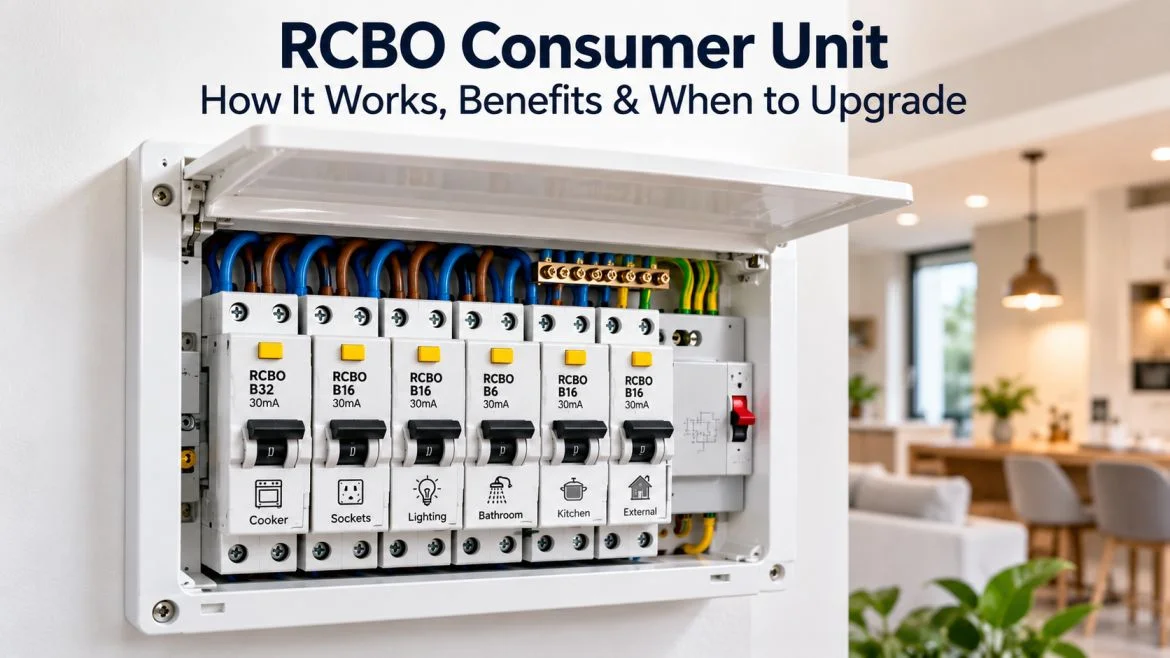
An RCBO consumer unit distributes electricity to your property’s circuits and gives each protected circuit its own device for overload, short-circuit, and residual-current protection. If a fault occurs on one circuit, its RCBO will normally disconnect that circuit while others remain powered. This can reduce disruption compared with several circuits sharing one RCD.
This guide explains how an RCBO consumer unit works, how it differs from an RCD consumer unit, its advantages, and when an upgrade may be worth considering.
What Is an RCBO Consumer Unit?
An RCBO consumer unit is a consumer unit, often called a fuse box, arranged with individual RCBOs protecting its outgoing circuits. RCBO stands for residual current circuit-breaker with overcurrent protection. Each device combines residual-current protection with the overload and short-circuit protection normally provided by an MCB.
The distinction between the device and the complete board matters. An RCBO protects a circuit; the consumer unit houses the devices and distributes the supply through its switches, busbar and connections. An ordinary main switch allows isolation but does not provide the protective functions of an RCBO.
What Does “Full RCBO Consumer Unit” Mean?
A full RCBO consumer unit generally means each outgoing final circuit has individual RCBO protection rather than sharing an RCD with other circuits. However, the description should still confirm the number of supplied devices, their ratings and whether surge protection is included.
A board advertised as suitable for RCBOs may be supplied with only an enclosure and main switch. Check the package contents before comparing its price with a fully populated unit.
How Does an RCBO Consumer Unit Work?
An RCBO disconnects its circuit when it detects an overcurrent condition or a qualifying imbalance between outgoing and returning current. These functions address different electrical problems: excessive loading, short circuits and current escaping from its intended path.
| Electrical problem | What happens | How the RCBO responds |
| Overload | A circuit carries excessive current for too long | Its overload function disconnects the circuit |
| Short circuit | An unintended connection produces a large fault current | Its short-circuit function operates rapidly |
| Residual-current fault | Current takes an unintended path, creating an imbalance | Its residual-current function disconnects the circuit |
The residual-current function monitors the balance between live conductors; it does not simply measure current in the earth wire. Where appropriately specified, it provides additional shock protection. However, it cannot prevent every electric shock, so correct wiring, earthing and other protective measures remain essential.
RCBO Consumer Unit vs Split-Load Consumer Unit: What Is the Difference?
The main difference is how residual-current protection is divided. In an RCBO consumer unit, circuits have individual protection. In a conventional split-load or dual-RCD board, several circuits share an RCD, while separate MCBs provide their overcurrent protection. A residual-current fault can therefore disconnect the whole group sharing that RCD.
| Feature | RCBO consumer unit | Conventional split-load or dual-RCD unit |
| Residual-current protection | Individual RCBO for each protected circuit | Shared RCD for several circuits |
| Overload and short-circuit protection | Provided by each RCBO | Provided by each circuit’s MCB |
| Residual-current fault | Normally disconnects the affected circuit | Can disconnect all circuits sharing the RCD |
| Leakage from different circuits | Assessed separately by their RCBOs | Combines at the shared RCD |
| Identifying the affected circuit | Usually more straightforward | May require checking several circuits |
| Equipment cost | Usually higher for equivalent provision | Often lower |
For example, a faulty dishwasher connected to a kitchen socket circuit may trip that circuit’s RCBO while separately protected lighting stays on. If those sockets and lights share an RCD, both may lose power when it trips.
This distinction applies particularly to residual-current faults. An overload in a split-load board may operate only the affected circuit’s MCB. Individual RCBO protection also cannot guarantee that every other circuit stays powered: upstream protection or a supply fault can still cause a wider outage.
What Are the Benefits and Limitations of RCBO Protection?
Individual RCBO protection can reduce the number of circuits affected by a residual-current fault, make fault finding more straightforward and separate leakage between circuits. These benefits are particularly useful where losing several circuits together would interrupt lighting, refrigeration, heating or other important equipment.
Can RCBOs Reduce Unwanted Tripping?
Electronic equipment can produce small leakage currents during normal operation. When several circuits share one RCD, those currents accumulate at the shared device. Separating circuits with individual RCBOs can reduce unwanted tripping caused by this combined leakage. Leakage within an individual circuit still needs consideration.
However, an RCBO upgrade does not guarantee an end to tripping. A faulty appliance, damaged wiring or excessive load can still operate the affected circuit’s device.
The main limitations are:
- Individual RCBOs usually increase equipment costs.
- Each device must suit its circuit and consumer-unit assembly.
- Existing wiring or appliance faults still require investigation.
- Replacing the board does not repair defects elsewhere in the installation.
A correctly designed split-load installation is not automatically unsafe simply because individual RCBOs offer better circuit separation.
How Do You Choose the Right RCBO Consumer Unit?
Choose an RCBO consumer unit according to the circuit count, supply characteristics, required protection and planned additions. Its suitability depends on the complete assembly and circuit design. An electrician should establish these requirements before selecting a board, rather than choosing solely by brand or enclosure size.
Check the Number of Circuits and Usable Spare Ways
Start with the actual circuit schedule, including lighting, sockets, cooking equipment, heating, showers and dedicated appliance supplies. Room count alone does not tell you how many circuits the property has.
Check how the manufacturer describes capacity. Module space refers to the physical width available for equipment; an outgoing way is a position available for a circuit device. Main switches, SPDs and other equipment occupy space, so enclosure capacity and usable circuit positions are not always the same.
If you plan an EV charger, garden office or heat pump, discuss it before installation. Spare positions are useful, but they do not establish that the supply or installation can support the additional demand.
Understand the RCBO Specifications
An RCBO has several ratings because its protective functions perform different jobs. For example, one device may be described as 32A, B-curve, 30mA, Type A, 10kA. These are separate specifications, not alternative descriptions of the same rating.
| Specification | What it tells you |
| Current rating, in amps | The rated current relevant to circuit loading and overcurrent protection |
| Residual-current sensitivity, in milliamps | The rated sensitivity of the residual-current function |
| B or C trip curve | The characteristic of the instantaneous overcurrent response |
| Type A, F or B | The residual-current waveforms the device is designed to detect |
| Breaking capacity, in kiloamps | Its specified ability to interrupt short-circuit current |
| Pole and neutral arrangement | How conductors are protected or switched |
B-curve and Type B mean different things. One describes overcurrent behaviour; the other describes residual-current capability. A device can therefore be B-curve and Type A at the same time.
The current rating must suit the cable, installation conditions and load. Residual-current type must suit the connected equipment: Type A covers AC and pulsating DC residual currents, while some equipment needs other protection arrangements. Selection should follow the circuit design and equipment manufacturer’s instructions.
Confirm Manufacturer-Approved Compatibility
An RCBO is not compatible just because it fits the mounting rail or has a matching amp rating. Terminal geometry, busbar connections and the assembly’s verified performance also matter. Even devices from the same brand may belong to ranges that are not interchangeable.
Use components approved for the specific consumer-unit range. BEAMA warns that mixing manufacturers’ devices or combining old and new components without verification can produce a non-conforming assembly.
Check What a Pre-Populated Board Includes
A pre-populated board comes with specified devices already supplied or fitted. A configurable board allows devices to be selected for the installation. Neither description removes the need to check that every circuit has appropriate protection.
Confirm the included RCBO quantities and ratings, surge protection, spare positions and any additional devices. A cheaper package may require extra components before it suits your property.
Mention Solar, Batteries and Planned Equipment
Tell the electrician about existing or planned solar generation, battery storage, EV charging and heat pumps. These can affect electrical demand, residual-current protection and the suitability of devices for the direction of supply.
For example, generation or storage equipment can introduce a source on the side normally treated as the load. Protective devices must be suitable for that arrangement, with bidirectional suitability established from the manufacturer’s information. Type A protection alone does not confirm suitability for every installation.
Does an RCBO Consumer Unit Need an SPD or AFDD?
An RCBO does not replace surge protection or arc-fault detection. These devices address different risks, and an RCBO consumer unit can incorporate them where required or appropriate. The words “full RCBO” do not confirm that either is included.
| Device | Main purpose |
| RCBO | Overload, short-circuit and residual-current protection |
| SPD | Limits transient overvoltages that can damage electrical equipment |
| AFDD | Detects specified dangerous electrical arcing conditions |
An SPD may be installed within the consumer unit, but its inclusion should be confirmed in the specification. AFDD protection requires a separate assessment of the premises, circuits and applicable requirements. Ask the electrician to explain what is required and what is recommended for your installation.
An RCBO installation cannot prevent every electrical fire. Suitable wiring, sound connections, correct installation and maintenance remain necessary.
Are RCBO Consumer Units Required in the UK?
Electrical installations need appropriate protection and must meet the applicable requirements. This does not mean every existing UK property must immediately receive a full RCBO board. Individual RCBOs are one way to provide residual-current and overcurrent protection while dividing circuits to reduce disruption.
As of 8 October 2026, BS 7671:2018+A4:2026 has been published. The previous version incorporating Amendments 2 and 3 remains valid during the transition until 15 October 2026. Installation specifications should identify the applicable version rather than relying only on a general “18th Edition compliant” description.
Domestic consumer units must also meet the applicable non-combustible enclosure requirements. These predate Amendment 2 and can be met by an appropriate non-combustible unit or cabinet arrangement. An existing plastic board should be assessed in context rather than treated as automatic evidence that the installation needs replacement.
Can You Upgrade an Existing Consumer Unit to RCBO Protection?
Sometimes RCBOs can be fitted to an existing board, but only where approved compatibility, available space and the installation design permit it. Otherwise, consumer unit replacement in London may be appropriate. The electrician should assess the existing circuits and protective measures before deciding which approach suits the property. .
Checks may identify issues involving:
- The enclosure and existing connections.
- Earthing and protective bonding.
- Circuit wiring and insulation.
- Shared or incorrectly connected neutrals.
- Existing faults requiring remedial work.
Replacing a consumer unit does not automatically mean the property needs rewiring. Equally, modern protective devices cannot make defective wiring acceptable. Assessment of the existing installation and verification of the completed work are essential parts of the replacement process.
What Certificates Should You Receive?
For a consumer-unit replacement, obtain an Electrical Installation Certificate (EIC) with the relevant inspection and test schedules. An Electrical Installation Condition Report (EICR) assesses an existing installation’s condition; it serves a different purpose from certification of the replacement work.
In England, replacing a consumer unit in a dwelling is notifiable under the Building Regulations. Confirm how notification will be handled and obtain the relevant compliance documentation. Arrangements differ across UK nations, so the installer should explain what applies to your property. GOV.UK
How Much Does an RCBO Consumer Unit Upgrade Cost?
The installed cost depends on the circuit count, board specification, additional protection, access and condition of the existing wiring. An equipment-only price does not represent a complete upgrade. The quotation should separate the planned installation from any remedial work that may be needed after assessment.
Ask whether the price includes:
- The specified enclosure, main switch and circuit RCBOs.
- Surge protection and any applicable additional protection.
- Installation labour and agreed alterations.
- Inspection, testing, labelling and certification.
- Notification arrangements where applicable.
- VAT, exclusions and approval of additional work.
Two quotations may differ because they cover different devices, circuit counts or remedial work. Compare the scope alongside the total, and ask whether the existing circuits have been assessed before accepting a fixed price.
What Should You Do If an RCBO Keeps Tripping?
Repeated tripping needs investigation. Possible causes include a faulty appliance, moisture, damaged wiring, excessive loading or residual-current leakage. The trip itself does not identify the exact cause, and replacing the RCBO without testing may leave the underlying problem unresolved.
Useful observations for an electrician include which circuit trips, whether it happens when particular equipment operates and whether there are visible signs of damage. Keep the consumer-unit cover fitted and do not touch internal wiring.
Avoid repeatedly resetting a device that trips again. Burning smells, scorching, unusual heat or crackling require urgent attention. Stop using affected equipment and seek electrical assistance. Do not bypass protection or increase the device rating to keep the circuit running.
How Should You Test and Maintain the Consumer Unit?
Operate the RCBO test buttons according to the manufacturer’s instructions and the consumer-unit label. Testing interrupts power to the protected circuit, so plan for that interruption. If a device fails to operate as instructed, arrange professional inspection.
The test button checks a function of the device; it does not confirm that the circuit wiring, earthing or all protective measures are satisfactory. Professional inspection and instrument testing remain separate. Keep the board accessible and report damage or abnormal operation promptly.
Is Your Consumer Unit Ready for an RCBO Upgrade?
If several circuits lose power together or you are planning new electrical equipment, contact London Safety Checks for an assessment. Our electrical safety testing services can help identify existing faults and establish whether your installation is suitable for an RCBO consumer unit upgrade.
Frequently Asked Questions
Is an RCBO the Same as an RCD?
An RCBO is a type of residual-current device that also includes overcurrent protection. An RCCB, often referred to simply as an RCD, provides residual-current protection without overload or short-circuit protection, so it requires appropriate overcurrent protection alongside it.
Does a 100A Consumer Unit Give Every Circuit 100A Protection?
No. A 100A description usually refers to a rating of the assembly or an included component, such as the main switch. Each circuit has its own protective-device rating. The property’s available supply and permissible loading must be assessed separately.
Can Another Circuit Always Be Added to a Spare Way?
No. A spare position provides physical space, but an additional circuit also needs suitable devices, supply capacity and an appropriate design. Its effect on the existing installation must be checked before connection.
Will an RCBO Upgrade Stop All Unwanted Tripping?
No. It can reduce tripping caused by leakage accumulating across circuits sharing one RCD. However, an individual circuit can still trip because of its own leakage, overload or fault. Investigating the cause remains necessary.
Does a New Consumer Unit Mean the Whole House Needs Rewiring?
No. Existing wiring may remain in service if assessment confirms it is suitable. If testing identifies defects, the required work could range from local repairs to more extensive replacement. The decision should follow inspection and testing rather than the consumer unit’s age alone.