
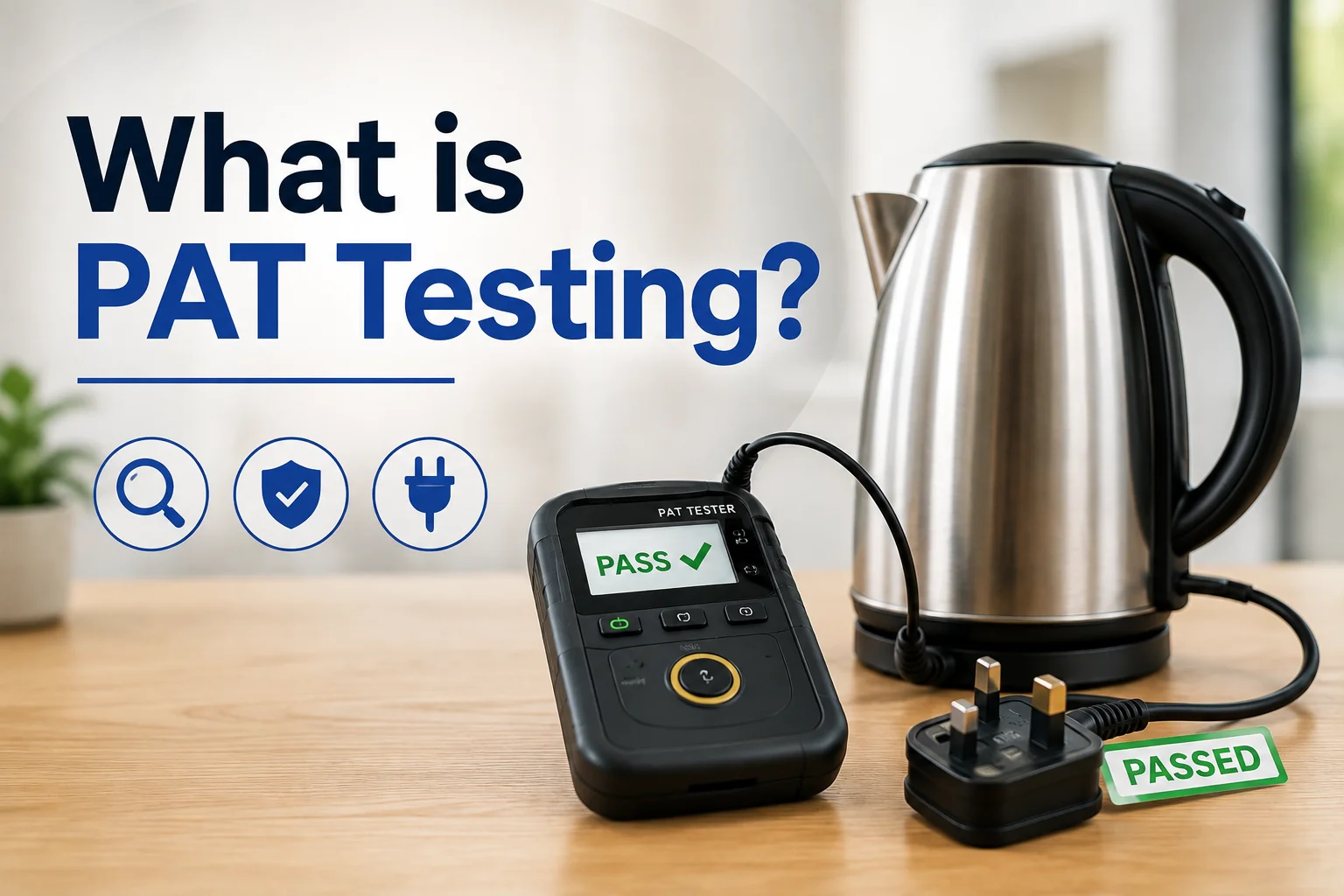
PAT testing is the process of visually inspecting and electrically testing portable electrical appliances to confirm they’re safe to use, catching problems like frayed cables, damaged plugs, or a faulty earth connection before they cause a shock, burn, or fire. It isn’t a specific legal requirement by name, but it’s the standard way businesses, landlords, and employers across the UK demonstrate they’re meeting their broader duty to keep electrical equipment safe. This guide walks through exactly what PAT testing involves, whether you’re legally required to do it, how often it needs doing, who’s allowed to carry it out, and what it typically costs.
What Is PAT Testing?
PAT testing is the inspection and testing of portable electrical appliances to confirm they’re safe to use. It combines a visual check for damage, frayed cables, cracked plugs, and scorched casings with an electrical test checking earth continuity and insulation resistance. This catches faults before they cause a shock, burn, or fire. The person responsible is called the duty holder an employer, landlord, or business owner.
PAT testing itself isn’t named in any single law. It’s a widely recognised method of meeting broader legal duties around electrical safety, which is where a lot of the confusion about “is it required” comes from, more on that below.
What Does PAT Stand For?
PAT stands for Portable Appliance Testing. The name is slightly misleading on its own, because the process is really two things combined:
- A visual inspection looking for physical signs of damage or wear
- An electrical test using a handheld PAT tester device to check the appliance actually performs safely under test conditions
Both parts matter. HSE guidance notes that the visual inspection alone catches the large majority of faults, but the electrical test picks up hidden problems like a damaged earth connection that you can’t see just by looking at the appliance.
What Is a Portable Appliance?
A portable (or “movable”) electrical appliance is any item that can be disconnected from the mains and moved, typically fitted with a plug and a cable. This covers a wider range of equipment than most people expect:
| Category | Examples |
| Small movable items | Kettles, toasters, hair dryers, desk lamps, irons, fans |
| Larger, rarely-moved items | Fridges, washing machines, photocopiers, water coolers, desktop computers |
| Battery-charging equipment | Phone chargers, laptop chargers |
| Extension leads | Extension cords, multi-way adaptors, connector leads |
| Portable items wired into the mains | Hand dryers, some towel rails |
Portable appliances also fall into two safety classes:
| Class | How it’s protected | How to spot it | Common examples |
| Class I | Earthed relies on a protective earth connection | Metal casing, plug has a metal earth pin, carries an earth symbol | Kettles, toasters, microwaves, fridges |
| Class II | Double insulated — no reliance on an earth connection | Plastic casing, carries a “square within a square” symbol | Drills, hedge trimmers, laptops, photocopiers |
Class I items are generally considered a slightly higher testing priority, because a damaged earth connection is a genuine shock risk that isn’t always visible.
Is PAT Testing a Legal Requirement?
No single UK law says that businesses must carry out PAT testing. However, several laws require electrical equipment to be kept safe and properly maintained. These include the Health and Safety at Work Act 1974, Electricity at Work Regulations 1989, PUWER 1998, and Management of Health and Safety at Work Regulations 1999.
None of these laws specifically require PAT testing or prescribe a particular testing method. Instead, they place responsibility on the duty holder to decide how electrical safety will be maintained and demonstrated. PAT testing is a widely recognised approach for documenting electrical safety, while a property compliance company can help landlords and property managers manage broader compliance requirements across their properties.
Is PAT Testing a Legal Requirement for Landlords?
For landlords, the picture is similar but with an added layer: alongside the general employer-style duties above, landlord obligations around electrical safety in rented homes are also shaped by tenancy and housing legislation. There’s still no law that says “landlords must PAT test,” but landlords are expected to ensure any appliances they supply kettles, ovens, washing machines provided with a furnished let are safe, and PAT testing is the practical way most landlords evidence that.
How Does PAT Testing Work?
PAT testing typically happens in three stages, each catching different kinds of problems:
- Routine user checks: informal, done by whoever actually uses the equipment day to day. No tools required, just a quick look for obvious damage.
- Formal visual inspection: a more thorough check by a competent person, following a set checklist. HSE notes this stage alone catches the large majority of faults.
- Manual instrument test: using a handheld PAT tester to check earth continuity, insulation resistance, and polarity, picking up faults that aren’t visible externally.
How to PAT Test (Step-by-Step)
Here’s what the formal visual inspection and test actually involve, item by item:
- Check the plug: Look for cracks, burns, or bent pins. Confirm the live, neutral, and earth wires are correctly and tightly connected to their terminals.
- Check the cable: Inspect the full length for fraying, cuts, or abrasion. Any exposed wire is an automatic fail.
- Check the appliance casing: Look for cracks, burns, corrosion, or general wear that could expose internal components.
- Check the mains socket: Not technically part of the PAT test, but worth including in the visual sweep: look for cracks, scorch marks, or a loose shutter mechanism.
- Test the RCD (if fitted): Press the test button to confirm it trips correctly, and check for physical damage.
- Check the environment: Look for trailing cable trip hazards, overloaded extension leads, or nearby water risks.
- Run the instrument test: Using a PAT tester, check earth continuity, insulation resistance, and (for Class I items) that the earth connection is sound.
- Record the result: Pass or fail, with the reason noted for any failure, and the item labelled with the test date.
A failed appliance should be taken out of use immediately and either repaired or replaced. A repaired item needs to pass a fresh test before it goes back into service.
What Needs to Be PAT Tested?
In general, anything with a plug and cable that connects to the mains falls under PAT testing. See the portable appliance table above for the full breakdown by category.
What Class Is a Fridge for PAT Testing?
A standard fridge is a Class I appliance. It has a metal casing and relies on an earth connection for protection, so it carries an earth pin on its plug.
Do New Appliances Need PAT Testing?
New appliances don’t legally need testing before first use. Most come with a manufacturer’s guarantee of safety out of the box. That said, many businesses choose to run a basic visual check and log new equipment into their testing schedule from day one, simply so nothing gets missed later.
Can You PAT Test Computers?
Yes. Desktop computers, laptops, and monitors are all portable appliances and fall under standard PAT testing; most are Class II (double insulated) items.
How Often Should PAT Testing Be Done?
There’s no fixed legal interval frequency is a risk-based decision made by the duty holder, based on the type of equipment, how often it’s used, and how risky the environment is. As a practical starting point:
| Environment | Equipment | Suggested Frequency |
| Office | Laptops, monitors, printers | Every 2–4 years |
| Staff kitchen | Kettles, microwaves, toasters | Every 1–2 years |
| Workshop/construction site | Power tools, extension leads | Every 3–6 months |
| Rental property | Landlord-supplied appliances | Annually, or at each new tenancy |
| Healthcare setting | Portable medical-adjacent equipment | Every 6–12 months |
| Retail / hospitality | POS equipment, kitchen appliances | Annually |
A drill used daily on a building site clearly needs checking more often than a printer that sits untouched in a quiet office, the table above is a starting point, not a rulebook. Ongoing user checks and visual inspections in between formal tests help catch problems early regardless of the schedule.
How Long Does a PAT Test Last?
There’s no legally fixed expiry date on a PAT test, validity is really just the flip side of the frequency question above. An appliance is generally considered “current” until its next scheduled test, based on the same risk assessment: a workshop power tool might need retesting in months, while an office laptop could reasonably go a couple of years. The “next test due” date on the appliance label is where this gets recorded in practice.
How Long Does a PAT Test Take?
For a single item, the actual test itself usually takes a few minutes, often 2 to 5 minutes per appliance once the tester is set up, depending on the type of equipment. For a full office of 50–100 items, a tester can typically get through everything in half a day to a full day. Homes and small businesses with a handful of appliances are often done within an hour.
Who Can Do PAT Testing?
PAT testing needs to be carried out by a “competent person”, someone with enough knowledge, training, and experience to do it safely and interpret the results correctly. This does not have to be a qualified electrician.
For low-risk environments like a typical office, a trained staff member can often handle formal visual inspections. For the instrument testing stage, or in higher-risk environments, most businesses bring in someone specifically trained and equipped for PAT testing.
For businesses that do not have trained staff or the right testing equipment, using a professional PAT testing service can provide a practical way to have portable electrical equipment inspected and tested properly.
Do You Need a Qualification to PAT Test?
There’s no legally mandated certificate or qualification required to carry out PAT testing. The law only requires the person to be “competent.” In practice, though, most insurers, clients, and landlords expect to see some form of recognised training, since it demonstrates the person actually knows what they’re doing and can be relied on if something is ever challenged.
How Much Does PAT Testing Cost?
Cost depends mainly on the number of items being tested and whether there’s a call-out fee involved. As a general guide:
- Per-item cost typically drops as volume increases: testing a handful of items costs more per item than testing a full office
- Call-out or minimum charge: many testers apply a minimum fee for small jobs to cover travel and setup time
- Domestic vs commercial rates: a landlord testing a handful of appliances in a rental property will usually pay a flat minimum fee, while a business with hundreds of items benefits more from bulk pricing
Getting a quote based on your actual appliance count is the most reliable way to get an accurate figure, since pricing varies by region and provider.
What Is a PAT Test Certificate?
A PAT test certificate (or report) is the documented record you receive once testing is complete. It typically includes:
- A list of appliances tested, with type, description, and location
- The test result for each item
- Details and reasons for any failures
- A pass/fail label on each appliance, showing the test date, next test due date, and the tester’s signature
There’s no legal requirement to keep these records, but it’s strongly recommended — they’re the main evidence you’d rely on to show due diligence to an insurer, auditor, or in the event of an accident investigation.
Summary
PAT testing is the process of visually inspecting and electrically testing portable appliances to confirm they’re safe to use. It isn’t named in law, but it’s the standard way of meeting broader duties to keep electrical equipment safe under acts like the Health and Safety at Work Act 1974 and the Electricity at Work Regulations 1989. Testing frequency is risk-based rather than fixed, competent (not necessarily qualified electrician) staff can carry it out, and keeping clear records protects you if safety is ever questioned.
FAQs
How often is PAT testing required?
There’s no fixed legal interval. It depends on the type of equipment and the risk level of the environment; see the frequency table above for typical ranges.
Is a PAT test a legal requirement in the UK?
No specific law mandates PAT testing, but it’s widely used to meet broader legal duties to maintain electrical equipment safely.
Who can carry out PAT testing?
Anyone deemed a “competent person” — trained, experienced, and able to correctly use and interpret a PAT tester. It doesn’t have to be a qualified electrician.
What does PAT testing involve?
A visual inspection of the plug, cable, and casing, followed by an instrument test checking earth continuity, insulation resistance, and polarity.
Do new appliances need PAT testing?
Not immediately! New items are generally considered safe out of the box, though many businesses log them into their ongoing testing schedule right away.