A blue fire extinguisher is a dry powder extinguisher. The blue band or label identifies it under the British colour-coding standard (BS EN 3), and it is built to fight solid, liquid, and gas fires with one universal powder agent. It’s often called an “ABC extinguisher” because of the fire classes it covers, and one common source of confusion is people assuming electrical fire is one of those classes, the system it’s actually a separate voltage rating printed alongside the A, B, C classification.
This guide clears that up, then covers everything else you actually need to know: what’s inside a blue extinguisher, when to use one, when not to, how to operate it correctly, and how it compares to the other extinguisher colours.
What a Blue Fire Extinguisher Is
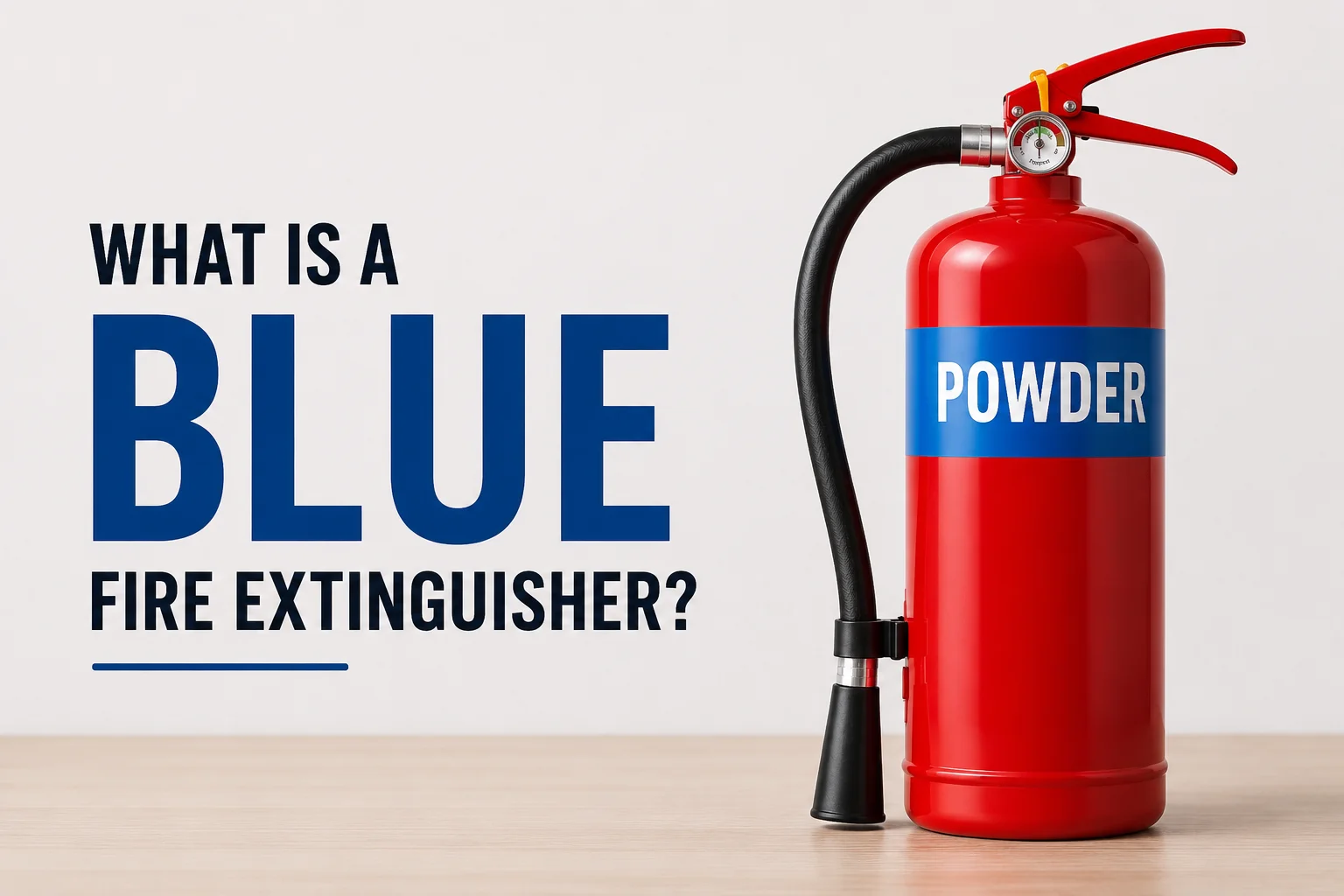
A blue fire extinguisher is a dry powder extinguisher, identified by a blue colour-coded band covering roughly 5–10% of the cylinder, sitting on a body that’s usually painted signal red, the base colour required for all extinguishers under BS EN 3. It discharges a fine chemical powder, typically monoammonium phosphate or a sodium/potassium bicarbonate blend, that smothers a fire by cutting off its oxygen supply and interrupting the chemical chain reaction that keeps a flame burning.
Dry powder extinguishers were originally developed for oil and chemical industry fires in the mid-20th century, and the multi-purpose ABC formulation became the standard version sold for general commercial and vehicle use from the 1980s onward, precisely because one agent could handle three different fire classes at once.
What Does a Blue Fire Extinguisher Contain?
A blue-coded fire extinguisher contains dry chemical powder. The exact formulation depends on its type, with ABC powder commonly based on ammonium phosphate and BC powder using bicarbonate-based compounds.
So, if you’re asking “what material does a fire extinguisher with a blue label contain?” The direct answer is: dry powder.
Always check the extinguisher’s label for its specific fire rating before use, as not every powder extinguisher is suitable for the same types of fire.
Which Fires It’s Rated For
Under the fire class system, a blue (dry powder) extinguisher is rated for Class A fires (solid combustibles like wood, paper, and textiles), Class B fires (flammable liquids like petrol, oil, and paint), and Class C fires (flammable gases like propane, butane, and methane), and it can also be used near live electrical equipment up to 1000 volts.
| Fire Class | Fuel Type | Blue Extinguisher Suitable? |
| Class A | Solid combustibles (wood, paper, fabric, coal) | Yes |
| Class B | Flammable liquids (petrol, paint, turps) | Yes |
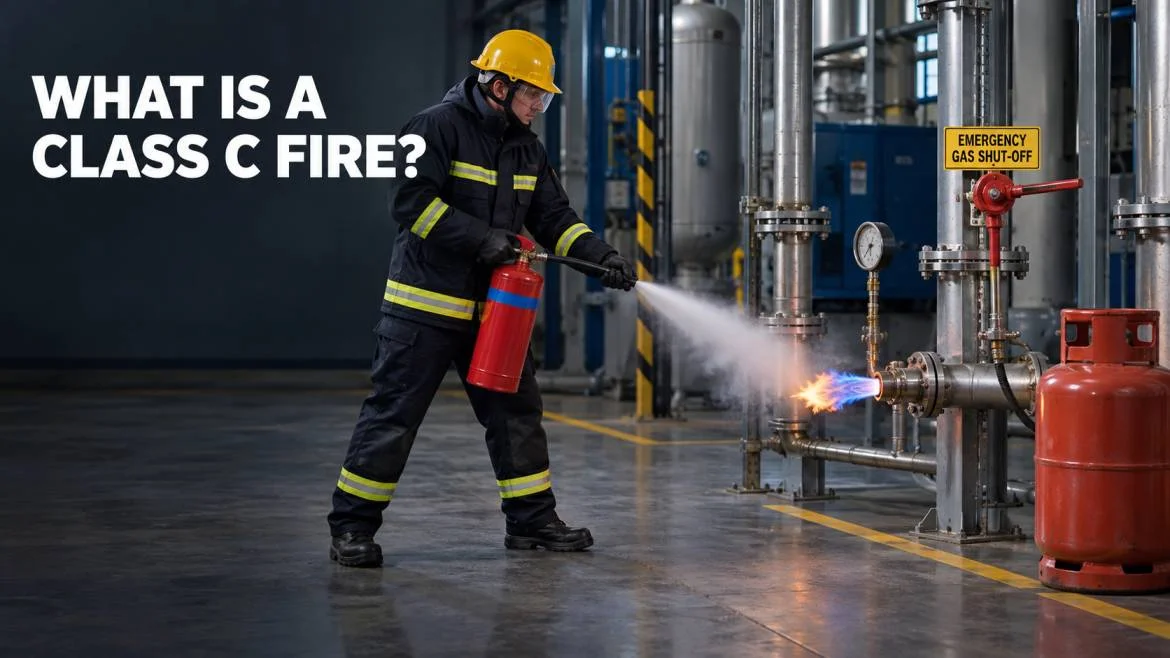
| Class C | Flammable gases (propane, butane, LPG, methane) | Yes |
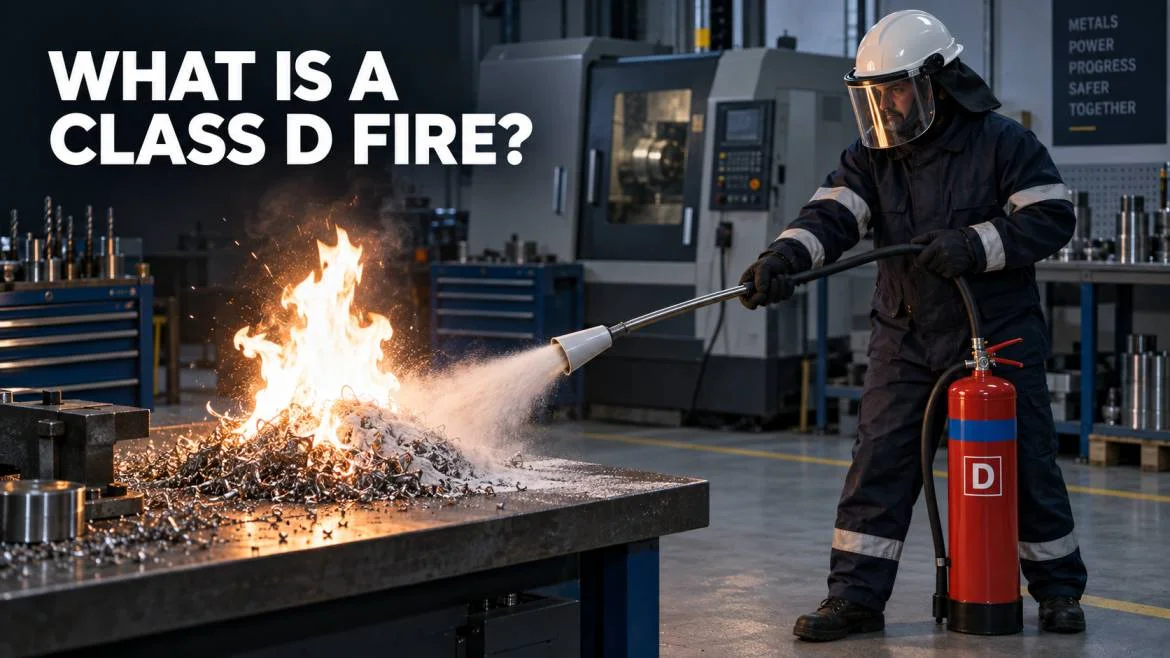
| Class D | Flammable metals (magnesium, titanium) | Only specialist L2/M28 powder types |
| Class F | Cooking oils and fats | No |
Electrical fire is not one of the lettered fire classes. It’s a separate rating, printed on the label as a voltage limit, because live current is a hazard present at a fire, not a fuel type in its own right. A blue extinguisher is safe to use near live equipment up to 1000 volts because the powder is non-conductive, and this rating sits alongside its A, B, and C classification rather than being part of it.
Fires It Must Never Be Used On
A blue dry powder extinguisher is not suitable for:
- Class F fires: burning cooking oil or fat in deep fryers and chip pans. The force of the powder discharge can splash burning oil outward and spread the fire rather than contain it. Use a wet chemical (yellow) extinguisher or a fire blanket instead.
- Electrical equipment above 1000 volts: beyond the rated voltage limit, the risk of conduction back through the discharge stream is unacceptable.
- Enclosed, unventilated spaces: the powder cloud reduces visibility to near zero within seconds and is a respiratory irritant when inhaled in volume, which is why fire risk assessments generally restrict powder extinguishers to open or well-ventilated areas, workshops, and outdoor or vehicle use rather than small offices or bedrooms.
- Flammable metal fires (Class D): standard ABC powder can react with burning metals like magnesium, titanium, or lithium. These require a specialist powder extinguisher graded L2 or M28, which uses a different graphite- or sodium-chloride-based compound designed for the extreme heat and reactivity involved.
How to Use a Blue Fire Extinguisher
The standard technique, taught in fire warden training, follows the acronym PASS:
- Pull the safety pin located at the top of the handle.
- Aim the nozzle at the base of the flames, not the smoke or the top of the fire.
- Squeeze the handle to release the powder in short, controlled bursts rather than one continuous discharge.
- Sweep the nozzle side to side across the base of the fire until it’s fully out.
Stand at least 2 metres back before discharging, and keep a clear escape route behind you at all times. Most standard 6kg powder extinguishers discharge fully in around 10–18 seconds, so aim is important: a missed sweep wastes agents you can’t get back.
When Should You Use a Blue Fire Extinguisher?
A blue dry powder extinguisher is suitable for Class A, B and C fires and can be used on live electrical equipment within its rated voltage. It is most useful in outdoor, well-ventilated and multi-risk areas such as garages, workshops, vehicles and industrial sites.
Suitable Situations
- Outdoor fires involving solids, flammable liquids or gases
- Garages, workshops and large, well-ventilated areas
- Fires involving multiple fuel types, such as gas and flammable liquids
- Live electrical equipment within the extinguisher’s rated voltage
Avoid Using It In
- Small or poorly ventilated rooms, where the powder cloud can severely reduce visibility
- Areas with people nearby, where inhaling the powder can cause irritation
- Around sensitive electronics, as the powder can contaminate and damage equipment
- Cooking oil or fat fires, which require a wet chemical extinguisher
Where Blue Extinguishers Are Required
Blue dry powder extinguishers are commonly specified for:
- Workshops, garages, and vehicle repair bays, where fuel, gas cylinders, and electrical tools are all present
- Warehouses and industrial units storing flammable liquids or LPG
- Construction sites, particularly where welding or flame-cutting is carried out
- Vehicles and forecourts, including company vans and fuel stations
- Boiler rooms and plant rooms in commercial buildings
They are generally not the primary extinguisher for offices, kitchens, or residential dwellings, where the enclosed-space and cooking-oil restrictions make water mist, CO2, or wet chemical extinguishers more appropriate as the first line of defence, with a powder extinguisher reserved as a secondary unit if outdoor or vehicle-related fire risk exists on the same premises.
Advantages and Disadvantages
Advantages
- Covers three fire classes (A, B, C) with a single agent, reducing the number of extinguisher types a site needs
- Safe for use near live electrical equipment up to 1000 volts
- Fast knockdown on liquid and gas fires compared with water
- Long service life, typically up to 10 years between full servicing when properly maintained
- Effective across a wide temperature range, making it suitable outdoors
Disadvantages
- No cooling effect, so Class A fires can reignite once the powder settles if hot embers remain
- Reduces visibility almost instantly, making it a poor choice in confined spaces or during evacuation
- Corrosive to sensitive electronics and machinery, and difficult to clean up afterward
- Unsuitable for Class F cooking oil fires
- Inhalation risk in enclosed areas, requiring ventilation immediately after use
Blue vs Other Extinguisher Colours
| Colour | Agent | Best for | Not for |
| Blue | Dry powder | Class A, B, C; electrical up to 1000V | Cooking oil, confined spaces |
| Red | Water | Class A only | Electrical, liquid, gas, oil fires |
| Cream | Foam | Class A and B | Electrical fires, gas fires |
| Black | CO2 | Electrical fires, Class B | Outdoor gas fires, no cooling effect on Class A |
| Yellow | Wet chemical | Class F cooking oil fires | Not general purpose |
Blue extinguishers are the most versatile by fire class coverage, which is exactly why they’re standard in mixed-risk environments like garages and industrial units, but that versatility comes at the cost of the clean-up and visibility issues above; it’s rarely the right single extinguisher for a normal office or home.
Want to read the full breakdown of the main fire extinguisher? Check out our guide on the 4 types of fire extinguisher and what each one is used for.
Maintenance and Inspection
- Extinguishers should be visually checked monthly for pressure gauge position, pin security, and physical damage
- A qualified fire extinguisher service should carry out a full service annually
- Powder extinguishers typically need an extended service, including internal inspection, every 5 years, and are usually replaced or recharged at the 10-year mark
- Store upright in a cool, dry location away from direct heat sources or flammable materials, and keep the mounting point clearly signed and unobstructed
Common Misconceptions
“Blue extinguishers are for electrical fires specifically.” Not accurate. Blue extinguishers are rated for solids, liquids, and gases, and are separately rated as safe to use near live electrical equipment up to a voltage limit. Electrical fire suitability is a safety rating, not a fire class.
“Any powder extinguisher works on any fire.” Standard ABC powder cannot be used on flammable metal (Class D) fires or cooking oil (Class F) fires both require specialist agents.
“More powder means it’s out for good.” Powder has no cooling effect, so smouldering material under ash or embers can reignite. The area should be monitored after use, even once visible flame is gone.
Need Help Choosing the Right Fire Extinguisher?
Choosing the right extinguisher depends on the type of fire risk, location, and equipment involved. If you’re unsure whether a blue dry powder extinguisher is suitable for your property, our fire safety team can help you choose the right option and keep your extinguishers properly serviced.
FAQs
What does the blue label mean on a fire extinguisher?
The blue label identifies the extinguisher as a dry powder type under the BS EN 3 colour-coding standard used across the UK and EU. It signals the extinguishing agent inside, not the size or manufacturer.
Can a blue fire extinguisher be used on an electrical fire?
Yes, up to the voltage limit printed on the label, commonly 1000 volts, because the powder is non-conductive. Above that limit, or for high-voltage equipment, a CO2 extinguisher is the safer choice.
What are the different types of blue fire extinguisher?
Blue extinguishers come in two main agent types: standard ABC powder (rated for Class A, B, and C fires) and BC powder (Class B and C only, not for solid fuels). By application, there are general-purpose powder extinguishers for everyday use, and specialist L2/M28 powder extinguishers for Class D flammable metal fires. They also come in different sizes, commonly 1–2kg for vehicles and 6–9kg for workshops and commercial premises, in either cartridge-operated or stored-pressure form.
How long does a blue fire extinguisher last?
A properly maintained dry powder extinguisher typically has a service life of up to 10 years, with an annual inspection and an extended internal service around the 5-year mark.
Is powder from a blue extinguisher dangerous to breathe?
In small amounts it’s a mild irritant, but a full discharge in an enclosed room can significantly reduce air quality and visibility. Ventilate the area immediately after use and avoid prolonged exposure.
What Is a Blue Band Fire Extinguisher For?
A blue band fire extinguisher is a dry powder extinguisher. It is commonly used on Class A, B and C fires, including solid materials, flammable liquids and gases. It can also be used on live electrical equipment within its rated voltage.
Blue powder extinguishers are particularly useful in garages, workshops, vehicles and industrial areas, but are generally unsuitable for small or poorly ventilated spaces because the powder can severely reduce visibility.
Do blue coded fire extinguishers contain dry powder?
Yes. Blue-coded fire extinguishers contain dry powder. Under the British and European BS EN 3 colour-coding system, a blue band or label on a red extinguisher identifies it as a powder extinguisher. The exact powder formulation can vary, so check the extinguisher’s label for its fire rating before use.
When should you use a blue fire extinguisher?
Use a blue dry powder fire extinguisher on Class A, B and C fires involving solid materials, flammable liquids and gases. It can also be used on live electrical equipment within its rated voltage.
It is best suited to outdoor or well-ventilated areas such as vehicles, garages and workshops. Avoid using it in small or enclosed spaces, where the powder cloud can reduce visibility and make breathing difficult.
Summary
A blue fire extinguisher is a dry powder extinguisher rated for Class A, B, and C fires, safe near electrical equipment up to 1000 volts, but unsuitable for cooking oil fires, high-voltage equipment, flammable metals, or enclosed spaces. Its versatility makes it the standard choice for workshops, vehicles, and industrial sites, but that same broad coverage means it’s rarely the ideal single extinguisher for an office or home, where the mess, visibility loss, and inhalation risk outweigh the benefit.